Reviews of

Author Archive

Theodore of Mopsuestia’s Biblical Exegesis in His Catechetical Homilies

In Brill, Marius Portaru, Patristic exegesis, Patristics, Theodore of Mopsuestia on March 9, 2026 at 9:54 pm

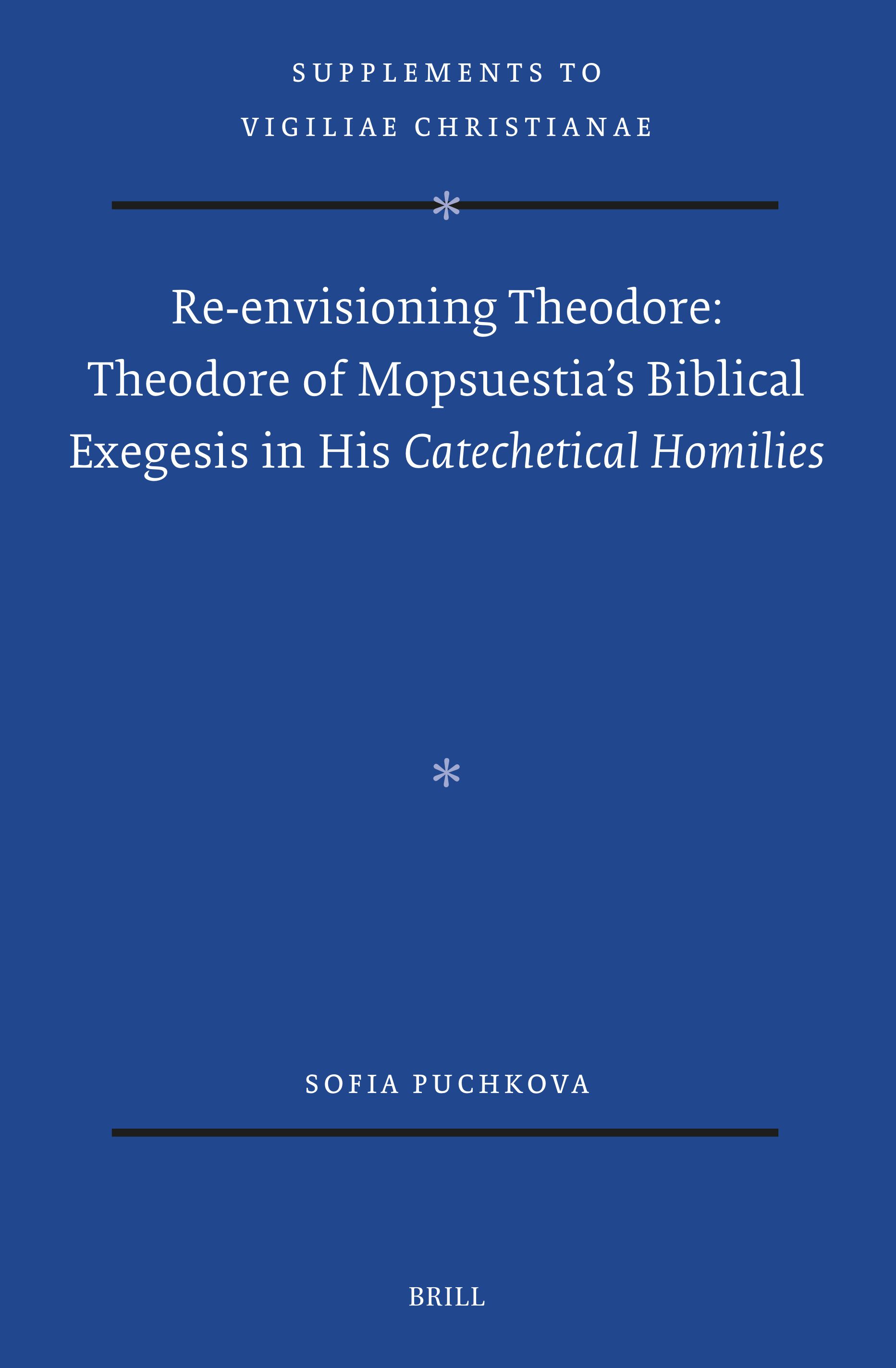
2026.03.02 | Sofia Puchkova. Re-envisioning Theodore: Theodore of Mopsuestia’s Biblical Exegesis in His Catechetical Homilies. SVC 185. Brill, Leiden-Boston: 2024.

Review by Marius Portaru, Pontificium Institutum Patristicum Augustinianum, Rome.

The present monograph addresses a gap in the scholarship on Theodore of Mopsuestia by examining his ‘invisible’ biblical exegesis in the Catechetical Homilies. While this topic was only briefly discussed in two previous studies by R. Greer and D. Keating (15), our monograph provides a comprehensive investigation: exploring the nature of Theodore’s exegesis, carefully identifying biblical quotations in the Catechetical Homilies (no less than 215 exegetical passages), comparing Theodore’s exegesis in his commentaries with that in the Homilies, and analysing Theodore’s connections with the pro-Nicene exegetical tradition, the Greco-Syrian liturgical tradition, John Chrysostom, and Origen. The outcome is a valuable contribution and an essential resource for anyone seeking to understand Theodore of Mopsuestia’s biblical exegesis in the Catechetical Homilies.

Read the rest of this entry »

The Lailashi Codex

In Hebrew Bible, Manuscript Studies, Manuscripts, Masoretic Pentateuch, Teófilo Correa, Textual Criticism, Thea GOMELAURI on January 3, 2025 at 2:19 pm

2025.01.02 | Thea Gomelauri (with a contribution by Joseph Ginsberg). The Lailashi Codex: The Crown of Georgian Jewry (Oxford, UK: Taylor Institution Library, 2023). 

Review by Teófilo Correa, Adventist International Institute of Advance Studies (AIIAS) 

The Lailashi Codex is an ancient Hebrew manuscript, considered the earliest nearly complete surviving medieval version of the Pentateuch (Ori Z. Soltes’ foreword). In light of its historical significance, Gomelauri offers a pioneering scholarly examination of the Lailashi Codex’s complex historical trajectory. The research chronicles the manuscript’s journey from a Jewish settlement in Svaneti, at the foot of the Caucasus Mountains, followed by its relocation to Lailashi village, and subsequent custodianship within the local Jewish community. The study further documents the codex’s requisition during the Soviet era and its ultimate repository at the National Centre of Manuscripts. 

In her analysis, Gomelauri elucidates the Lailashi Codex’s multifaceted importance, demonstrating its value beyond its liturgical function as a testament to the historical interconnection of Georgian and Jewish cultural traditions. The publication also reveals a notable finding in manuscript studies: identifying formerly missing folios of the Lailashi Codex by Joseph Ginsberg, currently preserved in the National Library of Israel collections.

Read the rest of this entry »
The Oldest Gospel and the Formation of the Canonical Gospels

In Canon, Jordan Almanzar, Marcion, Matthias Klinghardt, New Testament, Peeters, Synoptic Gospels, Synoptic theories on December 23, 2022 at 12:21 pm

2022.12.13 | Matthias Klinghardt. The Oldest Gospel and the Formation of the Canonical Gospels. Biblical Tools and Studies 41; Leuven: Peeters, 2021.

Review by Jordan Almanzar, Magdalen College of the Liberal Arts.

Matthias Klinghardt’s study, The Oldest Gospel and the Formation of the Canonical Gospels, is a two-volume work in which he proposes Marcion’s Evangelion as the key to explaining origins of the canonical Gospels. The work was inspired by a certain disharmony Klinghardt sees in 19th-century scholarship existing between two discourses that largely took place in Germany: 1) the so-called synoptic problem and 2) the relationship of Marcion’s Evangelion to canonical Luke. These discourses developed simultaneously yet independently of one another, and Klinghardt seeks to not only bring them together, but to display the results of doing so.

Read the rest of this entry »

Vom Bernstein zum Luchsstein

In Bryan Beeckman, Felix Albrecht, HB/OT, Septuagint, Universitätsverlag Winter on May 30, 2022 at 12:33 pm

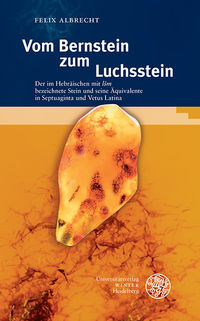
2022.05.06 | Felix Albrecht. Vom Bernstein zum Luchsstein. Der im Hebraïschen mit lšm bezeichnete Stein und seine Äquivalente in Septuaginta und Vetus Latina. Indogermanische Bibliothek. 3. Reihe, Untersuchungen; Heidelberg: Universitätsverlag Winter, 2021. ISBN 978-3-8253-4799-4.

Review by Bryan Beeckman, KU Leuven/UCLouvain.

In Vom Bernstein zum Luchsstein, Felix Albrecht examines the meaning of לֶשֶׁם (lšm; Ex 28:19 // 39:12), one of the twelve stones which were placed on the breastplate made for Aaron, the high priest. In order to reconstruct the origin and transmission history of lšm, Albrecht examines this specific lexeme in the different textual witnesses of the Hebrew Bible, i.e. the Masoretic Text (MT), the Septuagint (LXX) and the Vetus Latina (VL).

Read the rest of this entry »

Divine Discourse in the Epistle to the Hebrews

In Cambridge University Press, Hebrews, Jonathan Rowlands, Madison N. Pierce, New Testament on February 13, 2022 at 9:48 pm

2022.02.01 | Madison N. Pierce. Divine Discourse in the Epistle to the Hebrews: The Recontextualization of Spoken Quotations of Scripture. Society of New Testament Studies Monograph Series 178; Cambridge: Cambridge University Press, 2020. ISBN: 9781108495417.

Review by Jonathan Rowlands, St. Mellitus College.

In this monograph, Pierce argues that “the author of Hebrews uses divine discourse—the speech of God—in Hebrews to develop his characterization of God and by extension his broader argument … [such that] these speeches are crucial to his argumentation.” (2). This argument is made primarily with reference to the author’s use of ‘prosopological exegesis’ of Jewish Scriptures. This technique “interprets texts by assigning ‘faces’ (πρόσωπα), or characters, to ambiguous or unspecified personal (or personified) entities represented in the text in question … for clarity of understanding” (4). Following a discussion about prosopological exegesis in antiquity (6-20) and techniques for identifying its use (20-22), Pierce introduces the particular use of this technique in Hebrews, culminating in an overview of previous treatments of divine speech in Hebrews (28-33).

Read the rest of this entry »

A Latin-Greek Index of the Vulgate New Testament and the Apostolic Fathers

In Apostolic Fathers, Dan Batovici, Latin Christianity, Mohr Siebeck, New Testament, Theodore A. Bergren, Translation, Uncategorized, Vulgate on October 8, 2019 at 1:40 am

Bergren

2019.10.12 | Theodore A. Bergren. A Latin-Greek Index of the Vulgate New Testament and the Apostolic Fathers. WUNT 403. Tübingen: Mohr Siebeck, 2018. ISBN 978-3-16-156024-8.

Review by Dan Batovici, KU Leuven.

The structure of this volume—published in the primary WUNT series—is straight forward: a brief introduction explaining the intention of the volume, a short bibliography of the comparatively less-known editions of Latin translations of the Apostolic Fathers, acknowledgements, and the three sigla used throughout, before moving to the bulk of the book, which is the list of Latin words (and their Greek correspondents) found in the early translations of the New Testament and the Apostolic Fathers, organised alphabetically. Read the rest of this entry »

The Rhetorical Functions of Scriptural Quotations in Romans

In Anthony Royle, Brill, Intertextuality, Katja Kujanpää, New Testament, Quotations, Romans on June 3, 2019 at 11:20 am

Kujanpaa

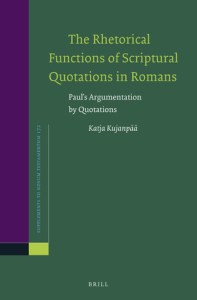
2019.6.6 | Katja Kujanpää. The Rhetorical Functions of Scriptural Quotations in Romans: Paul’s Argument by Quotations. Novum Testamentum Supplements 172; Leiden: Brill, 2018. 374 pp. ISBN 978-90-04-38293-0.

Review by Anthony Royle, Dublin City University.

Katja Kujanpää (University of Helsinki) dauntlessly has undertaken a rhetorical and text-critical analysis of every quotation of the Old Testament in Paul’s Letter to the Romans, which is an impressive achievement for a monograph. The enormity of this project, which is based on Kujanpää’s doctoral dissertation, means there is no space for comparative studies with citations in other Pauline letters or contemporary literature, narrowing the focus solely on Paul’s Letter to the Romans. Read the rest of this entry »

Inconsistency in the Torah

In HB/OT, Joshua A. BERMAN, Lindsey A. Askin, Oxford University Press, Pentateuch, Source Criticism, Uncategorized on March 20, 2019 at 6:06 pm

Inconsistency

2019.3.4 | Joshua A. Berman. Inconsistency in the Torah: Ancient Literary Convention and the Limits of Source Criticism. Oxford: Oxford University Press, 2017. ISBN 9780190658809.

Review by Lindsey A. Askin, University of Bristol.

Why do modern biblical scholars problematize disparity and dissonance in ancient law and narrative? Joshua A. Berman’s Inconsistency in the Torah explores this question in Pentateuchal criticism, critically approaching the methodological fallacies and analytical shortcomings that come as a result of becoming nobly but ideologically entrenched in detecting redactional layers diachronically in biblical and cognate texts (p.203). Read the rest of this entry »

Isidore de Péluse, Lettres III

In Editions du Cerf, Egypt, Egyptian Christianity, Epistolography, Isidore of Pelusium, Late Antiquity, Letter collections, Madalina Toca, Monastic letters, Monasticism, Nicolas Vinel, Patristics, Pierre Évieux, Uncategorized on January 31, 2018 at 5:40 pm

0lettres3

2018.01.03 | Pierre Évieux and Nicolas Vinel, eds. Isidore de Péluse, Lettres III (1701-2000). Sources Chrétiennes 586. Paris: Editions du Cerf, 2017.

Reviewed by Madalina Toca, KU Leuven.

Isidore de Péluse, Lettres III (1701-2000) is the third volume with Isidore’s letters in the Sources Chrétiennes series (SC 586), edited and translated in French by the late Pierre Évieux with the collaboration of Nicolas Vinel. Read the rest of this entry »

A Question of Beginnings, a Debate without End

In De Gruyter, HB/OT, Jürgen van OORSCHOT, Kurtis Peters, Markus Witte, review article, Uncategorized on January 11, 2018 at 9:33 am

Yahwism

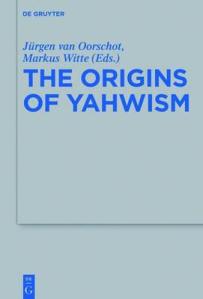
2018.01.01 | Jürgen van Oorshot and Markus Witte (eds.). The Origins of Yahwism. Beihefte zur Zeitschrift für die alttestamentlichen Wissenschaft 484. Berlin: De Gruyter, 2017.

Review article by Kurtis Peters, University of British Columbia.

Introduction

Among the long-standing controversial subjects in biblical studies the discussion surrounding the geographical and cultural origins of Yahweh worship sits comfortably. Read the rest of this entry »