Reviews of

Archive for the ‘Paul’ Category

Paul and the Miraculous: A Historical Reconstruction

In Baker Academic, Brandon Walker, Graham H. TWELFTREE, Miracle discourses, Paul on January 23, 2015 at 6:21 pm

patm

2015.01.01 | Graham M. Twelftree. Paul and the Miraculous: A Historical Reconstruction. Grand Rapids, MI: Baker Academic Press, 2013. 390 pp. Pbk.

Reviewed by Brandon Walker, University of Nottingham.

Many thanks go to Baker Academic for providing us with a review copy.

This latest book by Graham Twelftree illuminates the important, but often neglected issue of Paul and his relationship with the miraculous. Twelftree’s agenda in this book is to examine Paul’s understanding of the miraculous in his life and ministry (26-27). One important thesis that is set forth is that while Paul did not completely distance himself from being perceived as a miracle worker, he did not directly claim to perform miracles. The distinction is an important one. While Paul witnessed miracles occurring in relation to his preaching of the gospel, he did not lay personal claim to them. In other words, he did not claim the power-authority that caused the miracles.

The book is laid out in five sections and ten chapters. The first chapter lays out Twelftree’s methodological agenda in this chapter by gleaning Paul’s understanding of miracles in a historical reconstruction. Read the rest of this entry »

Contours in the Text

In Bloomsbury, Garrick V. Allen, Hebrew Bible, Jonathan D. H. NORTON, Josephus, Manuscripts, New Testament, Paul, Qumran, Romans, Scribal habits, Scripture, Second Temple, Septuagint, Textual Criticism on December 19, 2013 at 9:01 am

CIT

2013.12.23 | Jonathan D. H. Norton. Contours in the Text: Textual Variation in the Writings of Paul, Josephus and the Yahad. Library of New Testament Studies 430; London: T&T Clark, 2011. xiii + 210 pages (PB). ISBN 9780567521996.

Review by Garrick V. Allen, University of St Andrews.

Many thanks to Bloomsbury for providing a review copy.

facebook.com/RBECS.org

In this volume, Norton explores Paul’s reuse and awareness of multiple antecedent scriptural traditions in the textually pluriform environment of first century Palestine. His approach blends text-critical acumen and an awareness of exegetical issues in the contemporary discussion. His study “questions Paul’s awareness and encounter with textual plurality in Jewish scripture” (p. 1). Read the rest of this entry »

Pioneer and Perfecter of Faith

In Christology, Christopher A. RICHARDSON, Hebrews, Mohr Siebeck, Nicholas J. Moore, NT Theology, Paul, Pistis Christou on June 21, 2013 at 11:20 am

PPF

2013.06.11 | Christopher A. Richardson. Pioneer and Perfecter of Faith: Jesus’ Faith as the Climax of Israel’s History in the Epistle to the Hebrews. WUNT II/338. Tübingen: Mohr Siebeck, 2012. XI, 280 pp. Paperback. ISBN 978 3 16 150397 9.

Review by Nicholas J. Moore, Keble College, University of Oxford.

The debate over pistis Christou – whether this phrase refers to faith in Christ or the faith(fulness) of Christ – has generated a large literature focussing mostly on a few verses in Paul. Christopher Richardson’s monograph argues that the concept of Jesus’ faithfulness is clearly present in the New Testament, but in a place that few engaged in the pistis Christou debate have thought to look for it: the Letter to the Hebrews. Richardson’s study (a revision of his doctoral thesis completed under Francis Watson at Aberdeen in 2009) traces references to Jesus’ faithfulness throughout Hebrews in order to demonstrate that this is a recurring and important theme. Read the rest of this entry »

Miracle Discourse in the New Testament

In Brandon Walker, Duane F. WATSON, Gospel of John, Gospels, John, Miracle discourses, New Testament, Paul, Society of Biblical Literature, Socio-Rhetorical Interpretation, Synoptic Gospels on April 2, 2013 at 11:30 pm

MDNT

2013.04.03 | Duane F. Watson, ed. Miracle Discourse in the New Testament. Atlanta: Society of Biblical Literature, 2012. ISBN 1589831187.

Reviewed by Brandon Walker, University of Nottingham.

Many thanks go to SBL for kindly providing us with a review copy.

facebook.com/RBECS.org

Miracle Discourse in the New Testament is a collection of essays that were originally presented at the Society of Biblical Literature annual meeting in 2001.  Miracle discourse itself has been analyzed and critiqued since the Enlightenment and has come to the fore with the publication of the works of Wendy Cotter, Graham Twelftree and most recently Craig Keener. The papers presented in this particular volume dialogue with Cotter’s Miracles of Greco-Roman Antiquity and her latest work, The Christ of the Miracle Stories: Portrait through Encounter.  The book follows a canonical order and shows the advantages of examining miracle discourse from a socio-rhetorical method (15).

Read the rest of this entry »

Romans (Paideia Commentaries on the New Testament)

In Baker Academic, Frank J. MATERA, NT Theology, Paul, Romans, Samuli Siikavirta on December 13, 2012 at 9:09 am

Romans

2012.12.17 | Frank J. Matera, Romans. Paideia Commentaries on the New Testament. Grand Rapids: Baker Academic, 2010. 416 pages. (PB) $29.99. ISBN 9780801031892.

Review by Samuli Siikavirta, University of Cambridge.

Many thanks to Baker Academic for kindly providing us with a review copy.

facebook.com/RBECS.org

Frank J. Matera’s Romans commentary is meant for “students at the master’s level” (4) and, despite fulfilling this purpose well, it gives some food for thought to more advanced scholars alike. The Paideia series as a whole, in which Matera’s commentary stands, is student-friendly in its threefold exegetical subdivisions: “Introductory Issues” for the background, “Tracing the Train of Thought” for a focus on the rhetorical flow of the text and “Theological Issues” for the significance of the text for Pauline and, indeed, Christian theology from Antiquity through key points along the text’s history of interpretation to the present.

Read the rest of this entry »

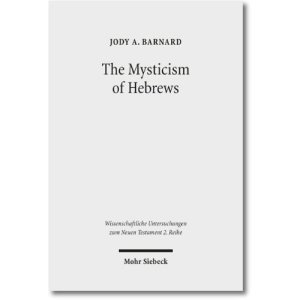
The Mysticism of Hebrews

In Apocalyptic, Hebrews, Jody A. BARNARD, Mohr Siebeck, Mysticism, New Testament, Nicholas J. Moore, Paul on November 13, 2012 at 11:44 am

2012.11.16 | Jody A. Barnard, The Mysticism of Hebrews. Exploring the Role of Jewish Apocalyptic Mysticism in the Epistle to the Hebrews. Wissenschaftliche Untersuchungen zum Neuen Testament 2.331. Tübingen: Mohr Siebeck, 2012. XII + 341 pp. Paperback. ISBN: 9783161518812.

Reviewed by Nicholas J. Moore, Keble College, University of Oxford.

Many thanks to Mohr Siebeck for kindly providing us with a review copy.

facebook.com/RBECS.org     [pdf]

Scholarship on the Epistle to the Hebrews has tended to divide over the most pertinent background against which to read the letter. On the one hand, scholars such as Spicq, Moffatt, and more recently Kenneth Schenck and Gregory Sterling, have sought to locate Hebrews within a Middle Platonic philosophical framework, with Philo as the most important comparative author. On the other hand, Ronald Williamson, C. K. Barrett, L. D. Hurst and Scott Mackie among others have emphasised the Jewish apocalyptic background of the letter. Read the rest of this entry »

Peter M. Head, “Onesimus and the Letter of Philemon: New Light on the Role of the Letter Carrier”

In Cambridge, Epistolography, Letter-carriers, New Testament, Oxyrhynchus, Papyrology, Paul, Peter M. HEAD, Peter Malik, SEMINAR REPORTS on May 31, 2012 at 4:15 pm

This is a report on a paper presented by Dr. Peter M. Head, Sir Kirby Laing Senior Lecturer in New Testament at the Faculty of Divinity and Tyndale House, at the New Testament  Seminar, Cambridge, 15 May 2012.

Report by Peter Malik, University of Cambridge. The programme of the New Testament Seminar at Cambridge can be found here.

facebook.com/RBECS.org

The final seminar of this academical year hosted a paper by Dr. Peter M. Head, Sir Kirby Laing Senior Lecturer in New Testament at the Faculty of Divinity and Tyndale House. Besides his 1997 monograph on the Synoptic Problem, Dr. Head is mostly known for his wide array of publications in the field of NT textual criticism, with a special focus on Greek NT manuscripts. Recently, however, he also published on ancient epistolary communication, particularly on named letter-carriers in Oxyrhynchus papyri and in ancient Jewish epistolary material (both can be accessed through Dr. Head’s website here). These are actually precursors of his forthcoming monograph on the role of letter-carriers in the interpretation of Paul’s letters. In this paper, Peter Head focused on the role of Onesimus as the letter-carrier of the letter to Philemon, and potential interpretive outcomes thereby gleaned. Read the rest of this entry »

Edward Adams, “Were the Pauline Churches House Churches?”

In Durham, Edward ADAMS, Galatians, Justin A. Mihoc, New Testament, Paul, Philippians, Romans, SEMINAR REPORTS on December 8, 2011 at 11:45 pm

This is a report on a paper presented by Dr Edward Adams, Senior Lecturer in New Testament Studies at King’s College London, at the New Testament Research Seminar, Department of Theology and Religion, Durham University, 5th of December 2011.

The list of forthcoming papers in the NT Research Seminars at Durham University can be found here. Like us on Facebook, here.

At the last session of the New Testament Research Seminar, Dr Edward Adams presented a very interesting and engaging paper on the identification of the early Christian meeting places. This presentation will be published as a contribution of a monograph on the same topic.

His analysis was focused on the undisputed Pauline epistles and the incidence and meaning of the phrase κατ᾽ οἶκον αὐτῶν ἐκκλησίᾳ (the church in their house). Read the rest of this entry »

John Barclay, “Paul and the Gift”

In Durham, Eerdmans, Galatians, John BARCLAY, Justin A. Mihoc, Paul, Romans on November 11, 2011 at 12:49 am

This is a report on a book preview by Prof John Barclay, Professor of New Testament Studies at Durham University, at the New Testament Research Seminar, Department of Theology and Religion, Durham University, 07th of November 2011.

The list of forthcoming papers in the NT Research Seminars at Durham University can be found here.

At the last assembly of the weekly New Testament research seminar, a new type of presentation was inaugurated. Prof Francis Watson, this session’s chair, introduced the format of book previews, a new and different one from the seminars we were used to so far. In these new sessions, the chair will get involved much more as a moderator, in a questions and answers format. For the first half of the session, the moderator will ask a set of questions which will enable the author and respondent to draw the general structure and themes of his book. In the second half, the open discussion, to which all participants are invited, would complete the already composed picture and further focus on the participants’ interests in the previously presented book.

Read the rest of this entry »

Benjamin Schliesser, “The Dialectics of Faith and Doubt in Paul”

In Abraham, Benjamin SCHLIESSER, Cambridge, Disputing, Doubt, Faith, Meddling, Paul, Romans, Samuli Siikavirta, SEMINAR REPORTS on October 13, 2011 at 12:21 pm

A report on a paper given by Dr Benjamin Schliesser (Zürich University) at the Senior New Testament Seminar of the Faculty of Divinity, University of Cambridge, 11 October 2011.

The list of forthcoming papers in the New Testament Seminars at Cambridge can be found here. You can also find us on facebook, here.

Dr Schliesser’s paper began with the realisation that he had made when writing his PhD thesis: the notion of doubt has not been dealt with much at all in Pauline scholarship. The doubt of Don Quixote, Descartes, Luther and the modern sceptic were all mentioned as examples that shape our present-day definition of the word “doubt”: uncertainty, hesitation, lack of confidence and wavering between two positions.

Most of the paper focused on Romans 4:20 and Paul’s use of διακρίνεσθαι therein. Dr Schliesser carefully showed the discrepancy between the classical/Hellenistic meaning of the verb (“to be separated or to be dissolved [into elements]”, “to come to a decision or to get it decided” or “to contend or to dispute”) and the way in which it is usually read in the New Testament (“to contend with oneself” or simply “to doubt”). Read the rest of this entry »