Reviews of

Archive for the ‘HB/OT’ Category

The Verbal System of Biblical Hebrew: A New Synthesis Elaborated on the Basis of Classical Prose

In Eisenbrauns, HB/OT, Jan JOOSTEN, Kurtis Peters, Linguistics, Simor Ltd on June 10, 2013 at 11:44 am

2013.06.10 | Jan Joosten. The Verbal System of Biblical Hebrew: A New Synthesis Elaborated on the Basis of Classical Prose. Jerusalem Biblical Studies vol. 10. Jerusalem: Simor Ltd, 2012.  ISBN: 965-242-009-10.

Review by Kurtis Peters, University of Edinburgh.

Many thanks to Simor Ltd and Eisenbrauns for kindly providing us with a review copy.

facebook.com/RBECS.org

There was little doubt that Joosten’s new volume, The Verbal System of Biblical Hebrew, would be thorough, well-researched, well-reasoned and well-positioned to become a standard for future scholarship. Read the rest of this entry »

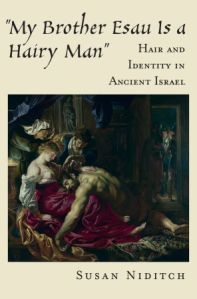
“My Brother Esau is a Hairy Man”: Hair and Identity in Ancient Israel

In HB/OT, Identity, JiSeong Kwon, Oxford University Press, Susan NIDITCH on May 22, 2013 at 9:48 am

Hairy

2013.05.09 | Susan Niditch. “My Brother Esau is a Hairy Man”: Hair and Identity in Ancient Israel. Oxford: OUP, 2008. Pp. 168. ISBN: 978-0-19-518114-2. Hardback.

Review by JiSeong Kwon, Durham University.

Many thanks to OUP for kindly providing us with a review copy.

In this book, Niditch argues that the growing, cutting, and altering of ‘hair’ in Israel reflect the significant social, historical, religious circumstances of the ancient Near East and help us to read the cultural meanings behind texts. Biblical descriptions with regard to the treatment of hair—various terms such as ‘hair’, ‘razor’, ‘shave’, ‘cut’, and ‘beard’—enable us to be aware of the common cultural/social context in the corresponding culture and time. Read the rest of this entry »

Reframing Biblical Studies

In Cognition, Eisenbrauns, Ellen van WOLDE, HB/OT, Kurtis Peters, Linguistics on April 23, 2013 at 2:48 pm

2013.04.06 | Ellen van Wolde. Reframing Biblical Studies: When Language and Text Meet Culture, Cognition, and Context. Winona Lake: Eisenbrauns, 2009. $49.50 pp. xiv + 402. ISBN: 978-1-57506-182-5.

Review by Kurtis Peters, University of Edinburgh.

Many thanks to Eisenbrauns for kindly providing us with a review copy.

facebook.com/RBECS.org

Ellen van Wolde’s recent volume, Reframing Biblical Studies, is an ambitious attempt to change the course of the whole of biblical scholarship. Biblical scholarship, she maintains, has become too narrow, too specialized, and does not have much ability to incorporate insights from other disciplines. Those who do attempt a crossover or integration often find themselves fumbling in the dark. Van Wolde, however, suggests a way forward, a light in a dark place – the study of cognition. It is by appeal to the human mind that we can form meaningful bridges between normally separated disciplines. Read the rest of this entry »

Pentateuch, Hexateuch, or Enneateuch?: Identifying Literary Works in Genesis through Kings

In Biblical Criticism, Genesis, HB/OT, Hermeneutics, Intertextuality, Kerry Lee, Konrad SCHMID, Pentateuch, Scribal habits, Scripture, Septuagint, Society of Biblical Literature, Thomas B. DOZEMAN, Thomas RÖMER on June 11, 2012 at 5:07 pm

2012.06.12 | Thomas B. Dozeman, Thomas Römer, and Konrad Schmid, eds. Pentateuch, Hexateuch, or Enneateuch?: Identifying Literary Works in Genesis through Kings. Ancient Israel and its Literature 8. Atlanta: SBL, 2011. x + 313 pages. $39.95. ISBN: 9781589835429.

Reviewed by Kerry Lee, University of Edinburgh.

RBECS would like to thank SBL for kindly providing us with a review copy.

facebook.com/RBECS.org

Pentateuch, Hexateuch, or Enneateuch? is a collaboration between the Pentateuch and Deuteronomistic History Sections of SBL Read the rest of this entry »

Genesis (New Cambridge Bible Commentary)

In Abraham, Biblical Criticism, Bill T. ARNOLD, Cambridge University Press, Genesis, HB/OT, Hermeneutics, Kerry Lee on May 4, 2012 at 3:54 pm

2012.05.08 | Bill T. Arnold. Genesis. The New Cambridge Bible Commentary. Cambridge: Cambridge University Press, 2009. xxii + 409 pages. (PB) £16.99. ISBN: 9780521000673. (HB) £50. ISBN: 9780521806077.

Reviewed by Kerry Lee, University of Edinburgh.

RBECS would like to thank CUP for kindly providing us with a review copy.

facebook.com/RBECS.org

Note to the reader: the following review is a good deal longer than what I would submit to an academic journal. In the process of reviewing this commentary, my own professional interest in the book of Genesis and in general hermeneutical method compelled me to address some issues in greater detail. Read the rest of this entry »

These Are The Generations: Identity, Covenant, And The ‘Toledot’ Formula

In Bloomsbury, Genesis, HB/OT, Kerry Lee, Matthew A. THOMAS, Pentateuch on March 9, 2012 at 9:05 pm

2012.03.07 | Matthew A. Thomas. These Are The Generations: Identity, Covenant, And The ‘Toledot’ Formula. Library of Hebrew Bible/Old Testament Studies 551. New York: T&T Clark, 2011. xviii + 153 pages. £65. ISBN: 9780567151414.

Reviewed by Kerry Lee, University of Edinburgh.

facebook.com/RBECS.org

In this published version of his PhD thesis, Matthew Thomas, who serves as adjunct professor at Fuller Theological Seminary and Azusa Pacific University, has engaged the problem of the relationship between the macro-structure of Genesis (and indeed, of the whole Pentateuch) and the toledot formulae, a long noted recurring feature with particular density in Genesis. Read the rest of this entry »

Richard Hays, “Retrospective Reading: The Challenges of Gospel-Shaped Hermeneutics”

In Edinburgh, Gospel of Mark, Gospels, Gunning Lectures, HB/OT, Hermeneutics, Intertextuality, John, Kerry Lee, Luke-Acts, Matthew, New Testament, NT Theology, Richard HAYS, Scripture on February 8, 2012 at 10:41 am

A report on a paper given by Richard Hays (Dean and George Washington Ivey Professor of New Testament at Duke University in Durham, NC), 26 January 2012. Professor Hays is delivering this year’s Gunning Lectures at New College, University of Edinburgh, on the topic “Israel’s Scripture Through the Eyes of the Gospel Writers.” I should note that Professor Hays has let me know that he is preparing a book for publication based upon these Gunning lectures.

RBECS is also on facebook, here.

The last of Richard Hays’ lectures in the 2012 Gunning series was part overview of the previous four lectures and part return to and exploration of the somewhat troubling assertion he made in his first lecture that modern hermeneutics (speaking, for the most part, in terms of the Christian church’s life and teaching) could and perhaps should imitate that of the Gospel writers. This assertion he expounded through nine proposals.

Rather than reporting on all of the first half of Hays’ lecture, let me refer the reader to the reports already posted on Mark, Matthew, Luke, and John. However, there were a few comments in this half of the lecture which were new and noteworthy. Read the rest of this entry »

Richard Hays, “The Temple of His Body: Reading Scripture with John”

In Edinburgh, Gospels, Gunning Lectures, HB/OT, Hermeneutics, Intertextuality, John, Kerry Lee, New Testament, Richard HAYS, Scripture, SEMINAR REPORTS on February 6, 2012 at 6:17 pm

A report on a paper given by Richard Hays (Dean and George Washington Ivey Professor of New Testament at Duke University in Durham, NC), 24 January 2012. Professor Hays is delivering this year’s Gunning Lectures at New College, University of Edinburgh, on the topic “Israel’s Scripture Through the Eyes of the Gospel Writers.” I should note that Professor Hays has let me know that he is preparing a book for publication based upon these Gunning lectures.

RBECS is also on facebook, here.

In the penultimate Gunning lecture, Richard Hays turned his attention to the fourth Gospel where, once again, Jesus is described as “him of whom Moses in the law and also the prophets wrote” (John 2:45, RSV). The character of Jesus makes this claim, as well, saying “If you believed Moses, you would believe me, for he wrote of me” (John 5:46, RSV). However, like the Synoptics, John does not say specifically where and how Moses and the prophets wrote about Jesus. Rather, it remains for the reader to reconstruct this.

Unlike the Synoptics, though, John’s use of the Old Testament depends on a very few allusions and citations (according to the count of Westcott and Hort, 27 direct citations in John versus 124, 70, and 109 citations in Matthew, Mark, and Luke, respectively), but these references are explored deeply over a longer stretch of the narrative, in what Hays calls sustained meditation. Read the rest of this entry »

Richard Hays, “The One Who Redeems Israel: Reading Scripture with Luke”

In Edinburgh, Gospels, Gunning Lectures, HB/OT, Intertextuality, Kerry Lee, Luke-Acts, New Testament, NT Theology, Richard HAYS, Scripture, Septuagint on January 26, 2012 at 5:40 pm

A report on a paper given by Richard Hays (Dean and George Washington Ivey Professor of New Testament at Duke University in Durham, NC), 23 January 2012. Professor Hays is delivering this year’s Gunning Lectures at New College, University of Edinburgh, on the topic “Israel’s Scripture Through the Eyes of the Gospel Writers.” I should note that Professor Hays has let me know that he is preparing a book for publication based upon these Gunning lectures.

RBECS is also on facebook, here.

Continuing in his investigation of the ways the Gospels use the Old Testament, Professor Hays turned, in his fourth Gunning lecture, to the Gospel of Luke. The launching point for Hays’ discussion was Jesus’ post-resurrection interaction with the disciples on the road to Emmaus in Luke 24:13-35. Focusing on the disciples’ ironic statement “We had hoped that he was the one who was going to redeem Israel” as a hermeneutical key to the narrator’s understanding of Jesus’ significance, and on Jesus response which took them through “Moses and all the Prophets” explicating himself, Hays identifies redemption as a recurrent theme in Luke and asks what is it in “Moses and all the Prophets” that points to Jesus as that redeemer. Read the rest of this entry »

Richard Hays, “Torah Reconfigured: Reading Scripture with Matthew”

In Edinburgh, Gospels, Gunning Lectures, HB/OT, Hermeneutics, Intertextuality, Kerry Lee, Matthew, New Testament, NT Theology, Richard HAYS, Scripture, SEMINAR REPORTS, Septuagint on January 25, 2012 at 8:29 am

A report on a paper given by Richard Hays (Dean and George Washington Ivey Professor of New Testament at Duke University in Durham, NC), 19 January 2012. Professor Hays is delivering this year’s Gunning Lectures at New College, University of Edinburgh, on the topic “Israel’s Scripture Through the Eyes of the Gospel Writers.”

RBECS is also on facebook, here

Professor Hays’ third lecture in the 2012 Gunning series focused on the Gospel of Matthew, whose use of the Old Testament has become a central feature of the scholarly characterisation of the New Testament’s overall appropriation of the Old Testament. Very often, the Gospel writers’ use of the Old Testament is understood as a series of proof-texts which show no concern for the meaning or context of the cited or alluded Old Testament reference. Professor Hays’ aim in these lectures, and especially in this one, is to challenge this view by closely reading the Gospels with special sensitivity to the unique narrative strategies of the individual writers.

The intertextual strategy of Matthew in many ways makes a striking contrast with that of Mark. Read the rest of this entry »