Reviews of

Archive for the ‘Patristic exegesis’ Category

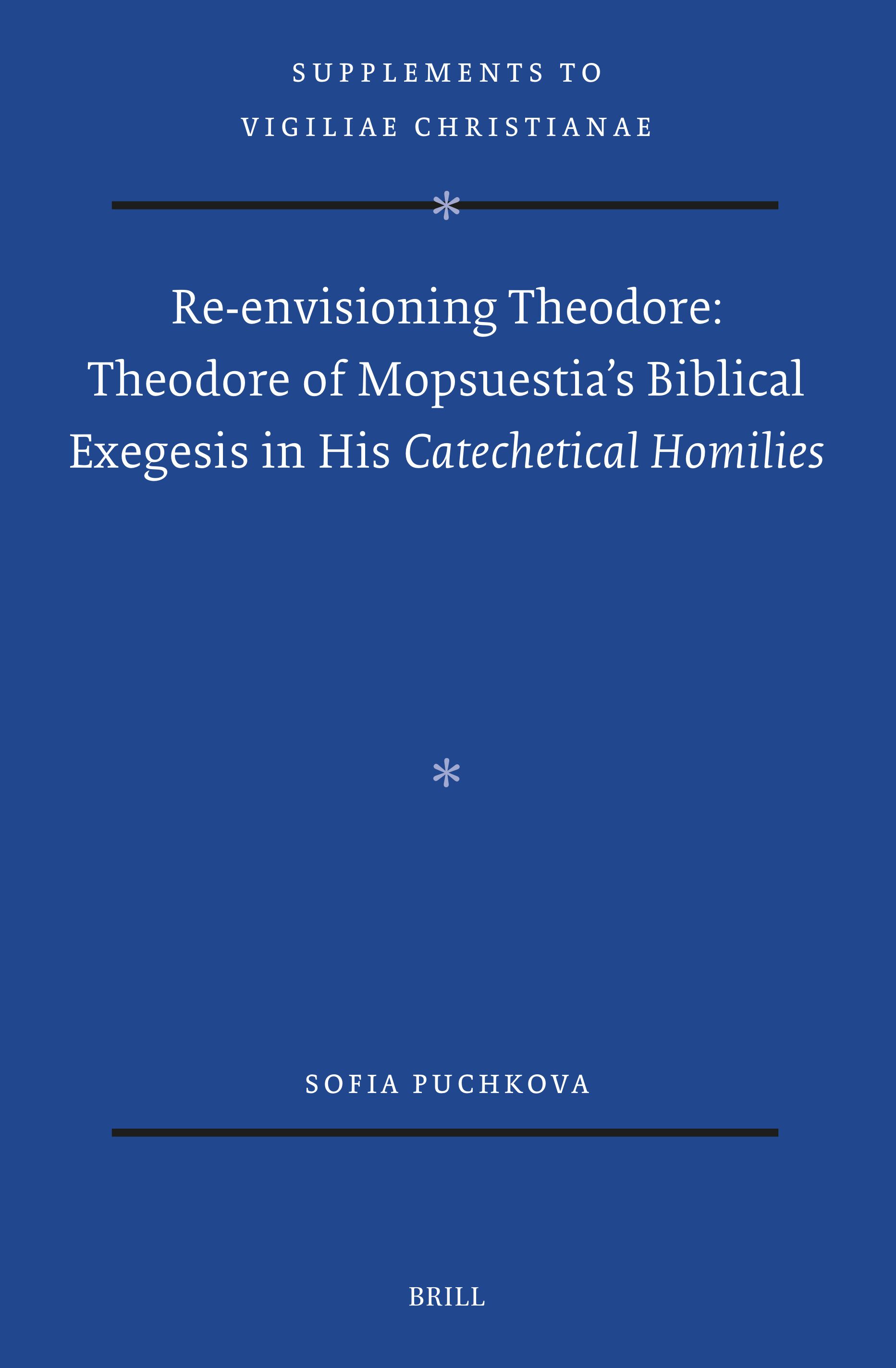
Theodore of Mopsuestia’s Biblical Exegesis in His Catechetical Homilies

In Brill, Marius Portaru, Patristic exegesis, Patristics, Theodore of Mopsuestia on March 9, 2026 at 9:54 pm

2026.03.02 | Sofia Puchkova. Re-envisioning Theodore: Theodore of Mopsuestia’s Biblical Exegesis in His Catechetical Homilies. SVC 185. Brill, Leiden-Boston: 2024.

Review by Marius Portaru, Pontificium Institutum Patristicum Augustinianum, Rome.

The present monograph addresses a gap in the scholarship on Theodore of Mopsuestia by examining his ‘invisible’ biblical exegesis in the Catechetical Homilies. While this topic was only briefly discussed in two previous studies by R. Greer and D. Keating (15), our monograph provides a comprehensive investigation: exploring the nature of Theodore’s exegesis, carefully identifying biblical quotations in the Catechetical Homilies (no less than 215 exegetical passages), comparing Theodore’s exegesis in his commentaries with that in the Homilies, and analysing Theodore’s connections with the pro-Nicene exegetical tradition, the Greco-Syrian liturgical tradition, John Chrysostom, and Origen. The outcome is a valuable contribution and an essential resource for anyone seeking to understand Theodore of Mopsuestia’s biblical exegesis in the Catechetical Homilies.

Read the rest of this entry »

The Apologists and Paul

In Bloomsbury, Jonathon Lookadoo, Patristic exegesis, Patristics, Paul on January 14, 2025 at 2:48 pm

2025.01.03 | Todd D. Still and David E. Wilhite. The Apologists and Paul. Pauline and Patristic Scholars in Debate. London: T&T Clark, 2024. Pp. xiv + 346. ISBN: 9780567715456.

Review by Jonathon Lookadoo, Presbyterian University and Theological Seminary, Seoul, Republic of Korea

The Apologists and Paul provides a wide-ranging analysis of how Paul’s letters were employed by that loosely defined group of early Christian writers known as the apologists. This volume is the fourth in the series, Pauline and Patristic Scholars in Debate, all of which have been co-edited by Todd Still and David Wilhite. Earlier compilations took up the use of Paul by Tertullian (2013), the Apostolic Fathers (2017), and Irenaeus (2020).

Read the rest of this entry »

Exegeting the Jews

In Brill, Gospel of John, Michael G. AZAR, Patristic exegesis, review, Simeon Burke on July 24, 2017 at 11:40 am

2017.07.16 | Michael G. Azar, Exegeting the Jews: The Early Reception of the Johannine “Jews”. The Bible in Ancient Christianity 10. Leiden: Brill, 2016. ISBN: 9789004308893

Reviewed by Simeon Burke, University of Edinburgh.

Following the Second World War, and particularly since the 1960s, scholars have simplistically described two millennia of Christian use of the “Johannine Jews” as “anti-Jewish”. This is the central claim of Michael Azar’s published Fordham doctoral thesis, Exegeting the Jews. Against this scholarly consensus, Azar enlists a trio of patristic authors – Origen, John Chrysostom and Cyril of Alexandria – each of whom applied John’s narrative of Jesus and the Johannine Jews in ways that do not easily conform to the categories and conclusions of the last fifty years of scholarship. The apparent hostility exhibited by the Fourth Gospel toward “the Jews” “did not function for Origen, Chrysostom and Cyril primarily as grounds for anti-Judaic sentiment, but rather as a scriptural resource for the spiritual formation and delineation of their Christian communities” (51). In other words, it was not “anti-Judaism” that fuelled their exegesis of the “Johannine Jews” but internal Christian concerns related to reading practices, ethics and orthodoxy.  Read the rest of this entry »

Clement’s Biblical Exegesis

In Brill, Clement of Alexandria, Jana PLATOVA, Judith L. KOVACS, Patristic exegesis, review, Robert G. T. Edwards, Veronika CERNUSKOVA on July 3, 2017 at 9:57 am

2017.07.14 | Veronika Černušková, Judith L. Kovacs, and Jana Plátová, Clement’s Biblical Exegesis: Proceedings of the Second Colloquium on Clement of Alexandria (Olomouc, May 29-31, 2014). Vigiliae Christianae Supplements 139. Leiden: Brill, 2017. ISBN: 9789004331235

Reviewed by Robert G. T. Edwards, University of Notre Dame.

Except for one essay, this book is based on papers presented three years ago at the Second Colloquium on Clement of Alexandria in Olomouc, Czech Republic. Whereas the first Colloquium in 2010 focused on Book VII of the Stromateis, this one focused on Clement’s biblical exegesis. The collection of essays is introduced by Judith Kovacs’ comprehensive overview of scholarship and issues related to Clement’s exegesis (pp. 1-37); this essay combined with Jana Plátová’s exhaustive bibliography (pp. 38-52) ably represents the state of the field. After these introductory chapters, the book is divided into three major sections: Part 1, “Clement’s Exegetical Methods”; Part 2, “Clement between Philosophy and Biblical Theology”; and Part 3, “Clement’s Exegesis of Particular Biblical Texts.”

Read the rest of this entry »

The Intertextual Reception of Genesis 1–3 in Irenaeus of Lyons

In Brill, Eric Covington, Genesis, Irenaeus of Lyons, Patristic exegesis, Patristics, Reception history, Stephen O. PRESLEY on January 13, 2016 at 11:15 am

presley

2016.01.02 | Stephen O. Presley. The Intertextual Reception of Genesis 1–3 in Irenaeus of Lyons (The Bible in Ancient Christianity; Leiden: Brill, 2015). Hardback. 267 pages + 34 pages bibliography & indices.

Review by Eric Covington, University of St Andrews.

Many thanks to Brill Publishers for providing a MyBook paperback inspection copy.

In The Intertextual Reception of Genesis 1–3 in Irenaeus of Lyons, Stephen O. Presley examines every reference to Gen 1–3 in Adversus Haereses (Against Heresies, abbreviated hereafter as Haer.) to demonstrate how Irenaeus interprets Genesis’ protological narratives within an intertextual network spanning the entire biblical canon.
Presley argues that Irenaeus’ intertextual exegesis is an outworking of his particular view of scriptural consonance informed by his doctrine of revelation and creation. Read the rest of this entry »