Reviews of

Archive for the ‘Brill’ Category

Radical Frame Semantics and Biblical Hebrew: Exploring Lexical Semantics

In Brill, Cognitive Semantics, HB/OT, Kurtis Peters, Linguistics, Stephen SHEAD on June 25, 2013 at 2:27 pm

2013.06.12 | Stephen Shead. Radical Frame Semantics and Biblical Hebrew: Exploring Lexical Semantics. Biblical Interpretation Series 108. Leiden; Boston: Brill, 2011. Pp. xxvii + 378. ISBN: 978-90-04-18839-6.

Review by Kurtis Peters, University of Edinburgh.

Many thanks to Brill for kindly providing us with a review copy.

facebook.com/RBECS.org

In recent years, there has been a slow but steady movement toward adapting modern linguistic theory to the study of biblical languages, particularly within lexical semantics – the study of word meaning. Shead’s Radical Frame Semantics represents yet another step forward in this general trend, and a strong one at that.

In this volume, Shead has clearly grasped the task at hand – to articulate a responsible method for handling the meaning of words in an ancient language – and has demonstrated convincingly that there is much to be gained from applying such a method.

Read the rest of this entry »

Angelomorphic Pneumatology: Clement of Alexandria and Other Early Christian Witnesses

In Angelomorphic, Bogdan Gabriel BUCUR, Brill, Clement of Alexandria, Dan Batovici, Early Christianity, Hermas, Patristics, Pneumatology on December 17, 2012 at 8:18 am

Angelomorph

2012.12.18 | Bogdan Gabriel Bucur. Angelomorphic Pneumatology: Clement of Alexandria and Other Early Christian Witnesses. Supplements to Vigiliae Christianae 95. Leiden, Boston: Brill, 2009. xxix + 232 pp. ISBN: 9789004174146.

Reviewed by Dan Batovici, University of St Andrews.

Many thanks to Brill for kindly providing us with a review copy.

facebook.com/RBECS.org  

This volume is the revised and amplified version of a PhD thesis written under Alexander Golitzin and defended in 2007 at Marquette University. From the outset, Bucur’s research on angelomorphic pneumatology (“that is, the use of angelic imagery in early Christian discourse about the Holy Spirit”, xxi) is proposed “as a complement to Charles Gieschen’s work on angelomorphic Christology and to John Levinson’s work on the angelic spirit in early Judaism” (xi).  Read the rest of this entry »

Early Christian Manuscripts: Examples of Applied Method and Approach

In Amulets, Brill, Dan Batovici, Early Christianity, Egypt, New Testament, Oxyrhynchus, Papyrology, Patristics, Reception history, Scripture, Textual Criticism, Thomas KRAUS, Tobias NICKLAS on June 13, 2012 at 6:12 pm

2012.06.13 | Thomas J. Kraus and Tobias Nicklas, eds. Early Christian Manuscripts: Examples of Applied Method and Approach. Texts and Editions for New Testament Study 5. Leiden, Boston: Brill, 2010. xx + 243 pp. ISBN: 9789004182653.

Reviewed by Dan Batovici, University of St Andrews.

Many thanks to Brill for kindly providing us with a review copy.

facebook.com/RBECS.org

This volume is intended as a papyrological follow-up of a previous volume, New Testament Manuscripts: Their Texts and Their World, published in the same series (TENT 2) in 2006. It features nine articles forming nine chapters varying in size between 15 and 45 pages. Read the rest of this entry »

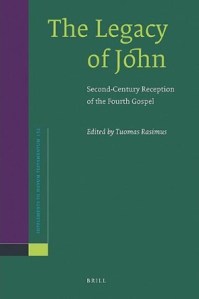
The Legacy of John: Second Century Reception of the Fourth Gospel

In Brill, Charles E. HILL, Dan Batovici, John, New Testament, NT reception history, Second century, Tuomas RASIMUS on January 17, 2011 at 8:37 am

2011.01.02 | Tuomas Rasimus, ed. The Legacy of John: Second Century Reception of the Fourth Gospel. Supplements to Novum Testamentum 132. Leiden/Boston: Brill, 2010. Pp. xi + 406. ISBN: 9789004176331. Hardback

Reviewed by Dan Batovici, University of St Andrews.

The book is a fine collection of twelve essays on several second-century texts and their relation to the Fourth Gospel. The editor mentions in the very dense introduction the need to ‘abandon the old division between “orthodox” and “heterodox” forms of Christianity as misleading and anachronistic.’

It is commendable, indeed, to seek for the early reception of John beyond such a distinction, and this fresh view stands well in a context in which the two most recent major contributions on the early reception of John tend to focus on either the “orthodox” or the “heterodox” reception. Read the rest of this entry »