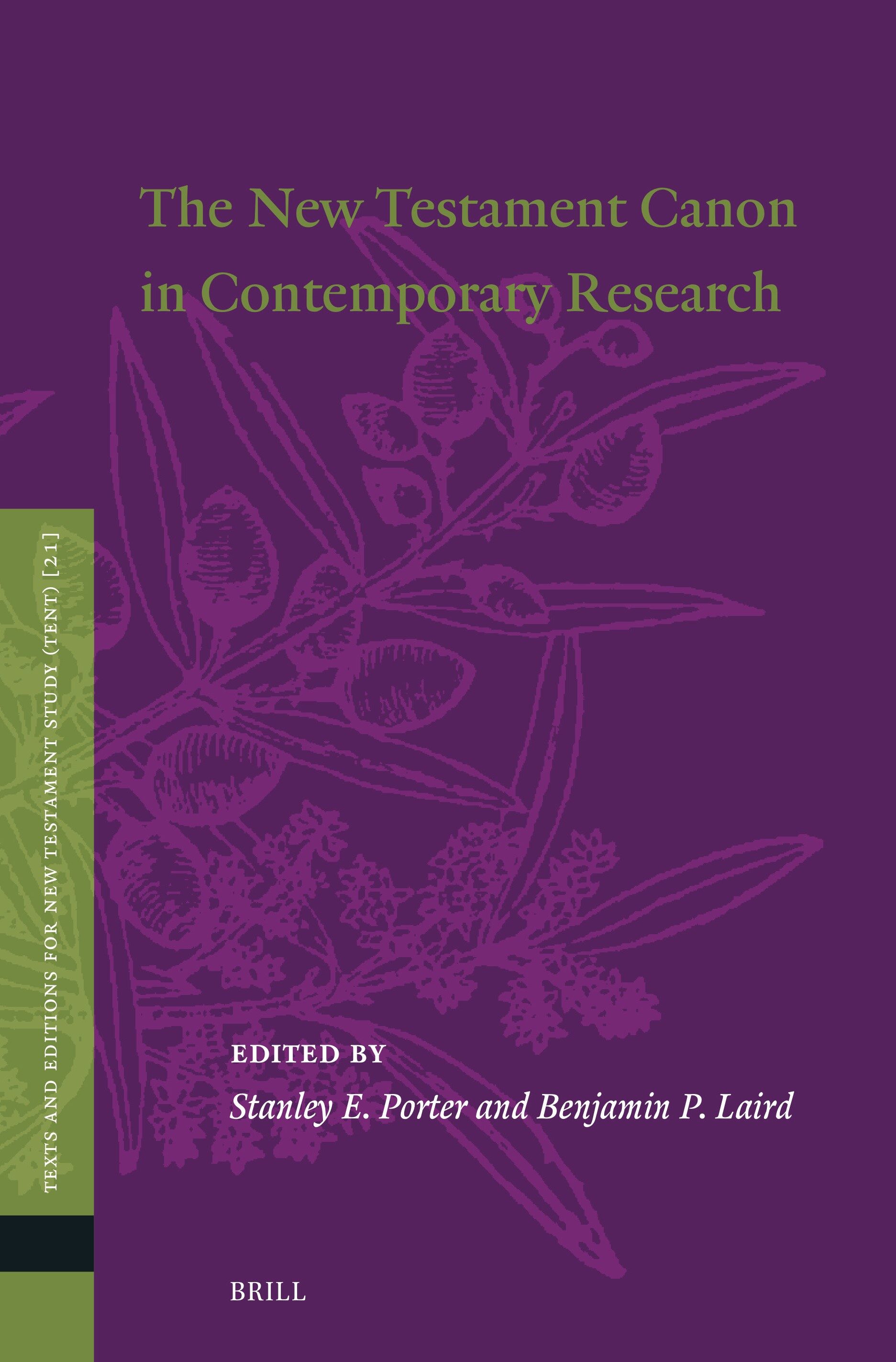
2026.09.07 | Stanley Porter and Benjamin P. Laird, eds. The New Testament Canon in Contemporary Research. Leiden: Brill, 2026. 656 pp., $185.00.
Review by Ched Spellman, Cedarville University
Stanley E. Porter and Benjamin P. Laird’s edited volume, The New Testament Canon in Contemporary Research, provides a wide-ranging examination of the historical formation, content, and reception of the New Testament canon. Bringing together twenty-three essays from scholars representing several different perspectives, the volume is organized around three major areas: the formation of the canon, the components of the canon, and the witnesses to the canon.
The first part considers the forces that contributed to canon formation, including inspiration, apostolicity, catholicity, the rule of faith, Gnosticism, Marcion, theological controversy, and ecclesiastical decisions. It also addresses the disputed chronology of canon formation, including competing arguments concerning when a recognizable core emerged and when the twenty-seven book New Testament became established.
The remainder of the volume examines how particular writings and collections acquired canonical status and what historical evidence reveals about that process. Contributors discuss pseudepigraphy, the fourfold Gospel collection, the Catholic Epistles, the Pauline corpus including Hebrews, and the complex reception of Revelation. The final sections turn from individual books and collections to the material and literary evidence for canon formation, examining ancient manuscripts, scribal practices, and patristic testimony.
Porter and Laird begin and end the volume with substantive orienting essays that map out the methodological terrain that the essays traverse (pp. 1–9, 562–71). Rather than advancing a single reconstruction of how the canon developed, Porter and Laird deliberately place competing scholarly interpretations alongside one another, making the volume a survey of both the evidence and the principal debates that characterize contemporary research on the New Testament canon.
As a resource for scholars and advanced students, The New Testament Canon in Contemporary Research is an excellent entryway into the challenging and rewarding field of canon studies. By design, its sections introduce readers to the most relevant primary sources and the major interpretive decisions necessary for making forays into this area of study. One challenge of canon studies is that the basic set of evidence rarely changes and is often frustratingly fragmentary. Consequently, the presuppositions, commitments, and methodological decisions of the interpreter or historian assume unusual importance. Taken as a whole, this volume makes these decisions visible while also establishing significant lines of continuity and shared conclusions among competing scholarly models, whether canonical, historical-critical, or history-of-religions paradigms.
One particular strength is its dedicated treatment of the catalysts for canon formation (pp. 15–174). Discussions of canon often focus on what the canon is and how it formed, while giving less attention to the question of why a New Testament came into being in the first place. The essays devoted to these catalysts showcase the range of interpretive frameworks brought to this question and demonstrate how judgments about the impetus for canon formation affect both the interpretation of biblical texts and the identification of the crucial period of canonical development, whether in the first century, the second century, or the fourth century and beyond.
In this vein, a prominent feature of the volume is the amount of overlapping discussion and repeated treatment of key documents and pieces of evidence. Rather than constituting a weakness, however, this repetition is one of the strengths of a collection of this kind. Within a single volume, readers can observe how sharply divergent approaches handle the same historical evidence and assess the methodological judgments that produce different reconstructions.
Several essays, for example, prioritize theological concepts such as apostolicity and inspiration as important factors in canon formation (pp. 15–58), while others question whether these concepts possessed sufficient historical coherence to function in such an account. Similarly, Marcion’s role ranges from relatively minimal in some reconstructions (pp. 177–99) to foundational in others (pp. 131–55), particularly for understanding the emergence of the very concept of a New Testament canon. Such juxtapositions are especially valuable in a field where new evidence is comparatively rare, and disagreements frequently concern the interpretation and weighting of familiar evidence. In addition to introducing readers to these crucial sources, it also provides a sustained demonstration of historical reasoning by allowing competing models to be compared at precisely those points where they encounter the same evidence.
In this respect, Porter and Laird’s volume represents an important update and development of a similar landmark work from an earlier generation, The Canon Debate (2002), edited by Lee Martin McDonald and James A. Sanders. The earlier collection addressed many of the same topics and established important parameters for subsequent discussion, while many essays in the present volume update those discussions through more recent research and further textual work. At the same time, a comparison between the two volumes demonstrates the enduring significance of particular bodies of evidence and interpretive questions. The persistence of these questions is itself instructive. In other words, a comparison with The Canon Debate reveals how durable the central problems of canon studies have proved to be. It also shows the meaningful ways that the framing and treatment of these topics have developed over the past two decades.
In sum, this collection essays draws upon the foundation established by previous generations of canon scholarship while identifying new pathways and new angles of approach to some of the field’s longest-standing questions. It can now serve as a standard point of orientation for contemporary study of the New Testament canon and is warmly recommended for practitioners in canon studies, scholars in related disciplines seeking a snapshot of current discussions, and advanced students looking for a comprehensive orientation to the field.
Ched Spellman
Cedarville University

