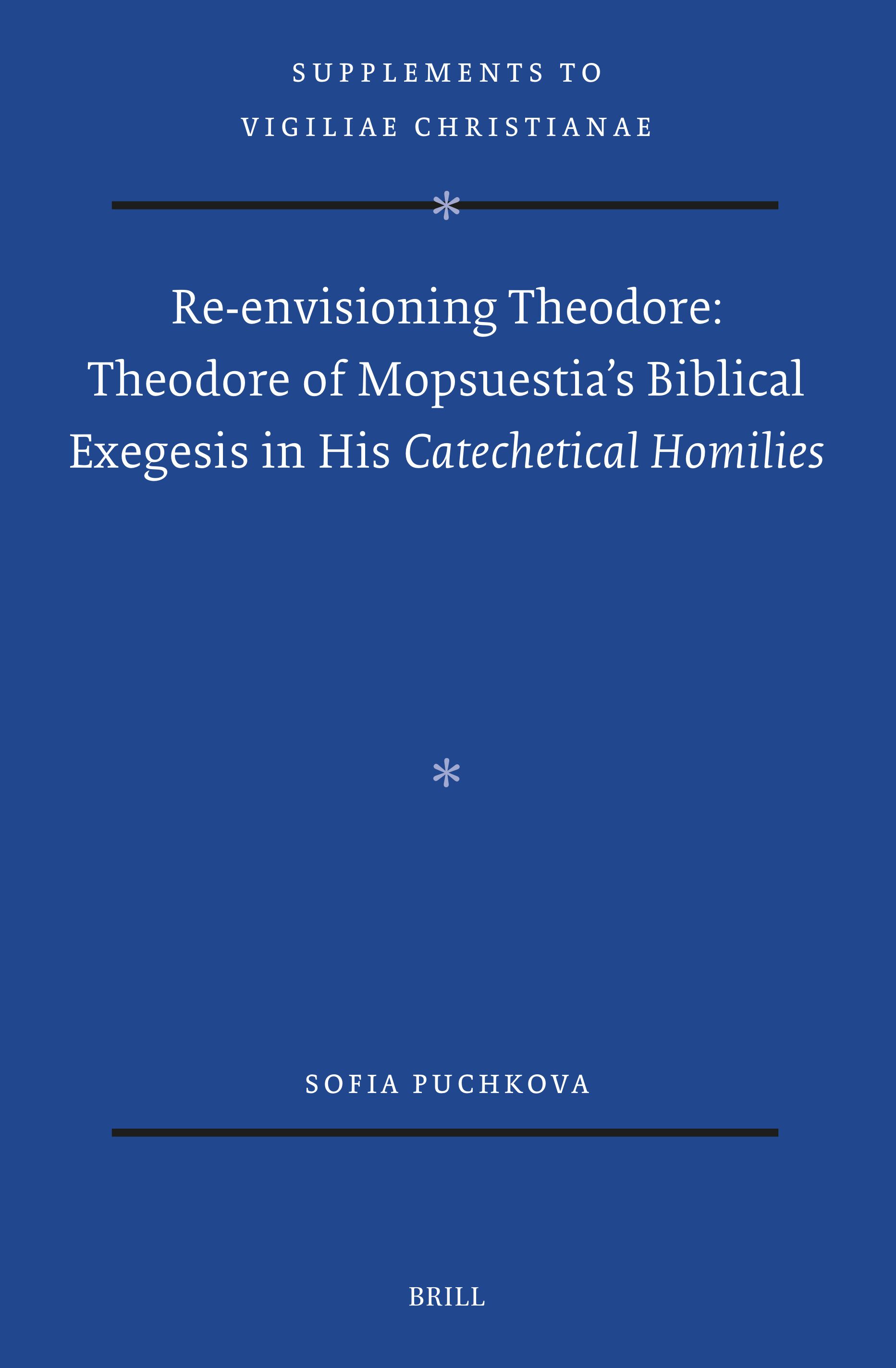
2026.03.02 | Sofia Puchkova. Re-envisioning Theodore: Theodore of Mopsuestia’s Biblical Exegesis in His Catechetical Homilies. SVC 185. Brill, Leiden-Boston: 2024.
Review by Marius Portaru, Pontificium Institutum Patristicum Augustinianum, Rome.
The present monograph addresses a gap in the scholarship on Theodore of Mopsuestia by examining his ‘invisible’ biblical exegesis in the Catechetical Homilies. While this topic was only briefly discussed in two previous studies by R. Greer and D. Keating (15), our monograph provides a comprehensive investigation: exploring the nature of Theodore’s exegesis, carefully identifying biblical quotations in the Catechetical Homilies (no less than 215 exegetical passages), comparing Theodore’s exegesis in his commentaries with that in the Homilies, and analysing Theodore’s connections with the pro-Nicene exegetical tradition, the Greco-Syrian liturgical tradition, John Chrysostom, and Origen. The outcome is a valuable contribution and an essential resource for anyone seeking to understand Theodore of Mopsuestia’s biblical exegesis in the Catechetical Homilies.
The author argues that there are two main reasons why Theodore’s biblical exegesis in the Homilies has remained ‘invisible’ to scholars: firstly, his exegesis is nearly indistinguishable from his doctrinal explanations; secondly, the Homilies have long been regarded as sources for Theodore’s theology or the history of liturgy (p. 16). The analysis of the biblical exegesis in the Homilies is approached from a methodological perspective that seeks to go beyond (i) the unilateral distinction between Antiochene and Alexandrian schools, and (ii) Theodore as a ‘historical’ exegete. Concerning (i), the opposition between the Alexandrian and Antiochene traditions is permeated by the influence of other exegetical traditions on Theodore’s biblical exegesis, such as the pro-Nicene tradition, which includes authors from the sphere of both Alexandria and Antioch, and Syrian liturgical traditions (p. 2 and 4). The search for connections across various exegetical and liturgical traditions and theological networks is used to ‘nuance’ the opposition between the literal and allegorical in respect of the two schools (or better, as the author specifies, ‘traditions’). Concerning (ii), the author contends that the depiction of Theodore as a strict ‘historical’ and literalist exegete results from focusing solely on his biblical commentaries, neglecting his exegesis in other works, such as the Homilies.
Ch. 1 offers an up-to-date introduction to Theodore’s life, his commentaries on the NT and the Catechetical Homilies. Ch. 2 tackles the indistinguishability between biblical exegesis and doctrinal explanation in the Homilies. With admirable rigour and skill, the author identifies approximately 215 exegetical passages, classifying their nine integration patterns (also grouped in a table at p. 45) and the types of quotations, distinguishing between primary and ancillary quotations. The main group of scriptural quotations corroborates Theodore’s theology; a second, much smaller, group is used to endorse the formulaic language of the councils; finally, a third group provides scriptural authority for formulas in liturgical rites and prayers. The OT quotations support Theodore’s monotheism. Texts from the letters of Paul and the Gospel of John represent almost 2/3 of the NT quotations. While the Catholic Letters and the Book of Revelation are never quoted in the Homilies, the Gospels of Luke and Matthew are invoked to illustrate the meaning of prayer and sacraments.
Ch. 3 compares Theodore’s exegesis in the Homilies with his exegesis in the commentaries (the catena fragments are set aside). This analysis reveals how his concern with the historical setting and historia in his biblical commentaries shifts towards pastoral concerns and ‘doctrinal’ exegesis in the Homilies. The predominant ‘doctrinal’ exegesis in the Homilies favours a selective, rather than a comprehensive and analytic, approach to the biblical text; it fosters a deductive method (F. Young) rather than attention to context, making Theodore’s exegesis less ‘historical’ and less literal. An entire subchapter is dedicated to the use of rhetorical figures, with the aim of illustrating how Theodore departs from the historia of the biblical text.
Ch. 4 examines Theodore’s exegesis in the Homilies in light of the broader exegetical traditions of the time, showing the author’s competence with Greek, Syrian, and Latin patristic works. ‘By exegetical traditions, I mean interpretative ideas that many authors of a particular historical period shared, stock interpretations, uses of particular biblical texts in doctrinal debates, etc.’ (p. 111). This investigation highlights Theodore’s connection with the pro-Nicene homoousian exegetical tradition (ten case studies of doctrinal exegesis), and the Greco-Syrian liturgical tradition (the live coal as a prefiguration of Communion, the metaphor of water as a womb in relation to Baptism). Another series of six case studies of interpretations that are infrequently, if at all, attested in other sources demonstrates Theodore’s exegetical ties to Chrysostom. Finally, the influence of Origen on Theodore seems to be only indirect.
An extensive Catalogue of Theodore’s Exegesis in the Homilies (pp. 151-239), providing a detailed description and analysis of all 215 exegetical passages, accompanies ch. 2. Appendix 1, A Referential Table to Theodore’s Exegesis According to the Type of Quotation (pp. 240-246), accompanies the same ch. 2. The types of quotation included are: single verse, composite quotation, sequential verses, separate verses, groups and episodes. Appendix 2, A Comparative Referential Table of Theodore’s Biblical Exegesis in the Catechetical Homilies and His Other Works (pp. 247-255), accompanies ch. 3 and shows the correspondence between the exegesis in the Homilies and Theodore’s preserved biblical commentaries, plus other works. All this makes the present monograph a very useful instrument of research into Theodore’s biblical exegesis.
Overall, this monograph represents a convincing attempt to bring to light Theodore of Mopsuestia’s biblical exegesis in his Catechetical Homilies, which remained hidden behind the doctrinal and pastoral concerns of the work itself. This complements our knowledge of Theodore’s exegetical profile by outlining his less historical exegetical procedures. Nevertheless, as the author remarks, his doctrinal exegesis can be labelled ‘literal’, and it does not result in allegory. Another notable achievement is taking Theodore out of the unilateral divide between the Antiochene and Alexandrian ‘schools’ and integrating him into the actual theological and liturgical ‘traditions’ of his time: the pro-Nicene homoousian biblical exegesis and the Syrian liturgical tradition. This demarche of presenting Theodore against a larger background could perhaps have been extended to the legacy of his doctrinal biblical exegesis: not only what he inherited from previous and contemporary theologians, but also what he passed on to later ones, such as Theodoret of Cyrrhus or Nestorius of Constantinople. But this and other possible missing investigations fall under the category of further research, and this essential contribution has the potential to open such paths.
Marius Portaru
Pontificium Institutum Patristicum Augustinianum, Rome.
mportaru@startmail.com

 Biblical and Early Christian Studies