Reviews of

Archive for the ‘Baker Academic’ Category

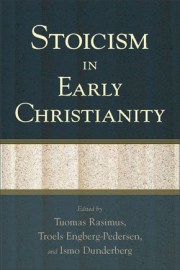
Stoicism in Early Christianity

In Baker Academic, Early Christianity, Ismo DUNDERBERG, New Testament, Samuli Siikavirta, Stoicism, Troels ENGBERG-PEDERSEN, Tuomas RASIMUS on August 1, 2013 at 5:01 pm

SEC

2013.08.17 | Tuomas Rasimus, Troels Engberg-Pedersen and Ismo Dunderberg (eds.). Stoicism in Early Christianity. Grand Rapids: Baker Academic, 2010. 320 pages. (PB) ISBN 9780801039515.

Review by Samuli Siikavirta, University of Cambridge.

Many thanks to Baker Academic for kindly providing us with a review copy.

Stoicism in Early Christianity is a collection of essays on a variety of topics suggesting that Stoicism rather than Middle Platonism was the predominant philosophical influence on early Christian texts. The emphasis on Stoic influence is seen as a neglected area in New Testament scholarship, which the book wants to change. Nearly half of the book’s thirteen essays are written by Nordic scholars (as one may expect of a book edited by two Finns and a Dane), but other authors range from universities in the USA, the Netherlands, Japan and South Africa. Read the rest of this entry »

Romans (Paideia Commentaries on the New Testament)

In Baker Academic, Frank J. MATERA, NT Theology, Paul, Romans, Samuli Siikavirta on December 13, 2012 at 9:09 am

Romans

2012.12.17 | Frank J. Matera, Romans. Paideia Commentaries on the New Testament. Grand Rapids: Baker Academic, 2010. 416 pages. (PB) $29.99. ISBN 9780801031892.

Review by Samuli Siikavirta, University of Cambridge.

Many thanks to Baker Academic for kindly providing us with a review copy.

facebook.com/RBECS.org

Frank J. Matera’s Romans commentary is meant for “students at the master’s level” (4) and, despite fulfilling this purpose well, it gives some food for thought to more advanced scholars alike. The Paideia series as a whole, in which Matera’s commentary stands, is student-friendly in its threefold exegetical subdivisions: “Introductory Issues” for the background, “Tracing the Train of Thought” for a focus on the rhetorical flow of the text and “Theological Issues” for the significance of the text for Pauline and, indeed, Christian theology from Antiquity through key points along the text’s history of interpretation to the present.

Read the rest of this entry »