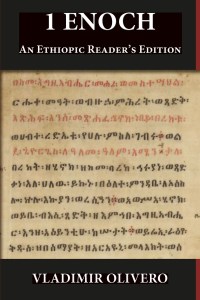
2026.03.04 | Vladimir Olivero. 1 Enoch: An Ethiopic Reader’s Edition. Resources for Biblical Study 110. Atlanta: SBL Press, 2025. pp. viii + 359. ISBN: 9781628377606.
Review by Kai Akagi, Rikkyo University.
While 1 Enoch is among the scriptures of the Ethiopic Orthodox Church and Geʿez serves as the liturgical language and language of scripture for various Ethiopic ecclesial traditions, in many parts of the world study of texts in Geʿez has long been limited to a very small number of specialists. Even in many specialist research works, use of 1 Enoch and other literature written preserved in Geʿez long was often limited to use of these texts in translation. The few who ventured into the study of Geʿez often did so through the introductory textbooks of either Lambdin or Mercer. While Mercer’s text had the advantage of simplicity and conciseness, its brevity left much to the student, particularly in becoming accustomed to reading through texts beyond its small number of short practice exercises. Lambin’s textbook, despite its general accessibility, ease of use, and a greater number of practice exercises, left reading in Geʿez script rather than transliteration to the discipline of the student, and many students never made the leap of reading longer texts in Geʿez script at all.
The past two decades and the past decade in particular, however, have seen a significant increase in scholars and students desiring to work in Geʿez, particularly among students and scholars in New Testament studies and Second Temple Judaism. This has been accompanied by the production of several introductory grammars, such as, in order of publication, Josef Tropper’s Altäthiopisch. Grammatik des Geʿez mit Übungstexten und Glossar (2002), Stephan Procházka’s Altäthiopische Studiengrammatik (2004), Amsalu Aklilu’s Geʿez Textbook ግዕዝ መማሪያ መጽሐፍ (2010), Rebecca Hasselbach-Andee’s English translation and revision of Tropper’s grammar as Classical Ethiopic: A Grammar of Gǝʿǝz (2021), and Archie T. Wright’s Basics of Ancient Ethiopic: A Complete Grammar, Workbook, and Lexicon(2022). The increased interest in Geʿez among many students may be considered a result of increased interest in apocalypticism, the relationship of early Christology to Second Temple messianism, and understanding early Christianity “within Judaism.” While many in New Testament studies are led into study of Geʿez through interest in the son of man figure in the Similitudes of Enoch, this has led to an increase in other literature preserved in Geʿez, such as the Ascension of Isaiah and Apocalypse of Peter.
Despite this increase in interest in Geʿez and grammars available for its study, moving from introductory study of grammar into the reading of longer texts is still a significant step. Vladimir Olivero’s 1 Enoch: An Ethiopic Reader’s Edition is a significant work providing assistance in that step, and it may be anticipated that its use will contribute effectively to increased fluency in reading Geʿez.
Olivero’s volume consists of a 21-page introduction, followed by the Geʿez text of 1 Enoch with notes on pages 23 through 220, and a combined lexicon and concordance on pages 221 through 359. The introduction surveys the structure, language, manuscripts, and critical editions of 1 Enoch, and explains the volume and its use.
The main body of the volume is formatted in a manner similar to other reader’s editions, with the Geʿez text of 1 Enoch on the upper part, and notes with glosses and parsing on the lower part, of each page. The text of this edition reproduces that of Rylands Ethiopic MS 23. As Olivero notes in the introduction, the orthographic irregularities of the manuscript are retained, which itself may aid students in moving from introductory grammars (which, while mentioning common irregularities in their explanations, do not include them in their practice exercises) into reading Geʿez texts and manuscripts, in which such irregularities occur frequently. Unlike many reader’s editions, glosses are provided for all verbs and nouns rather than only those that are less frequent, facilitating use of this edition even by those who have acquired only a very limited vocabulary. As Olivero notes in the introduction, the glosses provided are contextual glosses mostly based on Knibb’s translation, and thus usually only one or two glosses are provided for each word. This facilitates reading without excessively cluttering the notes with longer lists of glosses for each word.
The extensive lexicon and concordance lists all words (except, reasonably, prefixed ወ- [wa-]) that occur in 1 Enoch. The entry for each word lists the word in both Geʿez script and transliteration followed by a gloss or glosses and a list of occurrences (chapter and verse, along with the number of occurrences in the verse in the case that the word occurs more than once in a single verse). Lists of occurrences are included even for common grammatical words, such as prefixed prepositions and pronouns. Proper nouns and numerical signs are each listed separately in the lexicon/concordance
The lexicon draws from Wolf Leslau’s Comparative Dictionary of Geʿez (1991) for its glosses, and the lexicon often provides several glosses for words, showing the various ways in which they are used, including uses that do not occur in 1 Enoch. For example, the entry for ተዋቀሠ (tawāqaśa), which occurs only once in 1 Enoch in 1:9, provides the glosses “to contend, contradict, dispute, argue a case, defend a case, make intercession, have a controversy, discuss, refute, plead, reprove, reject, bring to judgement, be brought to judgement, accuse each other, go to court.” While perhaps more than necessary for reading 1 Enoch, these lists of glosses have three advantages that increase the usefulness of the volume: (1) they aid those who use the volume to consider various interpretive possibilities for terms where they appear in the text of 1 Enoch; (2) they increase the usefulness of the lexicon as a reference to be used while reading other Geʿez texts; and (3) they contribute to increased knowledge of Geʿez vocabulary and its varied uses.
Olivero has provided a wonderful tool facilitating the study of Geʿez and improving reading ability. It excels in clarity and ease of use, and it allows students to begin working through one of the most widely studied Geʿez texts from a relatively early stage in the study of Geʿez language. I will confidently recommend this volume to students who venture into the study of Geʿez and its literature.
Kai Akagi
Rikkyo University
kakagi [at] akagiresearch.com

 Biblical and Early Christian Studies