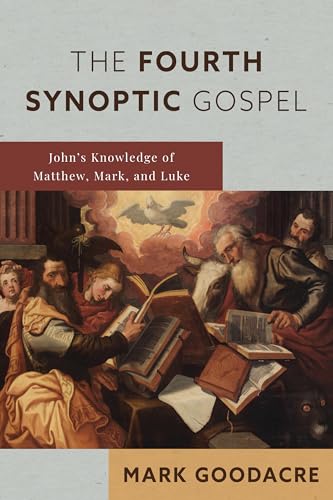
2026.01.01 | Mark Goodacre. The Fourth Synoptic Gospel: John’s Knowledge of Matthew, Mark, and Luke. Eerdmans, 2025. 191 pp.
Review by Ched Spellman, Cedarville University.
Goodacre advances a straightforward thesis: John’s Gospel was written with an awareness of the Synoptic Gospels. More specifically, Goodacre argues that the author of this Gospel “knew, used, presupposed, and transformed the Synoptics” (p. ix). For Goodacre, “the significant literary parallels between the Synoptic Gospels and John” represent good enough evidence to conclude that John was familiar with the final form of these texts. In other words, “the author of the Fourth Gospel did not use Synoptic-like traditions but the Synoptic Gospels themselves” (p. 17).
For most of Christian history, this would not have been a controversial claim. Early patristic testimony consistently viewed John’s Gospel as a culminating textual and theological witness. With the rise of the modern era, the intellectual and interpretive groundwork was laid that led to a decisive shift in the most commonly accepted view. Among other factors, the fascination with fluid oral traditions, the location of original audience in isolated communities, and the critical reconstruction of hypothetical sources used in the production of the Jesus tradition all contributed to the notion of a Johannine witness that was independent of the Synoptic Gospels. In recent years, of course, several of these methodological blocks at the bottom of the Jenga tower of formerly fixed consensus have been nudged out of place. The resulting tumble has opened up space in the scholarly guilds for new methodological configurations and fresh formulations of older paradigms.
In this scenario, Goodacre’s scholarship has helped establish a strong base upon which to build comparative and exegetical work on the New Testament Gospels. In The Case Against Q (2002), he argued that the “double tradition” material shared by Matthew and Luke is best explained by Luke’s direct use of Matthew (the Farrer Hypothesis), rather than a lost sayings source (“Q”). In Thomas and the Gospels (2012), he extended this logic to the Gospel of Thomas, arguing that its parallels to the Synoptics are the result of literary dependence rather than an independent, primitive oral stream. The present volume participates in this project by seeking to demonstrate that John’s working knowledge of the Synoptics is more plausible than alternative possibilities. Part of the throughline of these studies is a strong “skepticism about our ability, as scholars, to discover hypothetical sources, lost editions, and hidden layers, when that quest can lead us to miss extant sources that are right before our eyes” (p. x).
After surveying and complexifying the reasons usually given for John’s independence, Goodacre establishes and clarifies the nature of the connection between these literary texts. He begins by drawing parallels in overall literary structures, such as the pattern of a passion narrative with an extended introduction, which he sees as shared between John and Mark. He then moves to more granular levels of comparison, arguing that specific “redactional fingerprints” from Matthew and Luke can be detected in Johannine material, and that the Fourth Gospel presupposes Synoptic narratives that it does not recount in exactly the same way. Goodacre pays close attention to both agreements—such as verbal and structural echoes—and differences, interpreting the latter not as evidence of independence but as evidence that John transformed his sources, reshaping them for his own theological and narrative purposes.
In the latter part of the book, Goodacre explores what he sees as the implications of this synoptic familiarity. He discusses how John’s narrative strategies, including its use of direct speech and its dramatic reconfiguration of characters (notably the figure of the “beloved disciple”), interact with a readership presumed to know the Synoptic portraits of Jesus. He also examines Christological developments, showing how titles and themes common to the Synoptics are adapted in distinctive ways within John’s theological framework. By situating John within the same literary trajectory as the Synoptics, Goodacre presents the fourth gospel as a deliberate culmination to the existing written tradition.
The book concludes by suggesting that many features traditionally attributed to a unique Johannine community are actually better explained as the result of a single author’s sophisticated engagement with Mark, Matthew, and Luke. As Goodacre summarizes, “Although it is customary to make dramatic distinctions between the Synoptics and John, there are several ways in which John behaves like a fourth Synoptic Gospel” (p. 161). These ways are not uniform but span a wide range of compositional strategies: “from similar words and phrases, to parallel passages, to similar sequences of passages, to the structure of the whole gospel, and the work’s basic literary conceit—the story of a hidden Messiah who is properly understood only by insiders, and only retrospectively after the experience of the resurrection” (p. 161).
In the end, Goodacre’s proposal encourages readers to envision the Fourth Gospel as the product of careful reading rather than accidental convergence or exclusively independent development. That assumption, once granted, drains much of the force from approaches that rely on distance, isolation, or lost intermediaries. In light of the lean elegance of this thesis, many familiar explanations for Johannine uniqueness begin to look unnecessarily elaborate. The result is a portrait of John’s Gospel that is no less theologically ambitious, but far more textually grounded.
Ched Spellman
Cedarville University
cspellman [at] cedarville.edu

 Biblical and Early Christian Studies
[…] us to consider John’s “Nathanael from an Indian Perspective,” while Ched Spellman reviewed and recommended Mark Goodacre’s The Fourth Synoptic Gospel. Bart Ehrman alerted readers to an obscure infancy gospel, The History of Joseph the […]