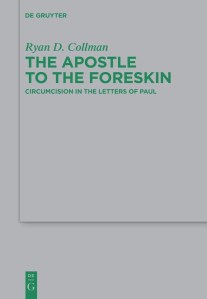
2024.10.07 | Ryan D. Collman. The Apostle to the Foreskin: Circumcision in the Letters of Paul. BZNW 259. Berlin: de Gruyter, 2023.
Review article by Paul T. Sloan, Houston Christian University.
“Foreskin” stretches across Paul’s letters as a part of various discourses concerning proper Law-keeping and the relation of Jews and gentiles to one another, to Abraham, and to God. The topic of circumcision naturally cuts across the same arguments. Often scholars only survey the tip of the iceberg when it comes to these topics, but Ryan Collman has provided a detailed study on the related passages. While Pauline scholars have routinely claimed that Paul “redefined” or “spiritualized” circumcision such that physical circumcision of Jews is made “redundant and obsolete” (p. 6) and that “the circumcision” as a usual metonymy for Jews is instead employed by Paul to refer to the Jew/gentile Christian community, Collman argues that Paul “held none of these views about circumcision” (p. 6). Instead, Paul “upholds the practice and value of circumcision for Jews. He does not redefine it, replace it, declare its irrelevance, or expand its application to non-Jews – metaphorically or otherwise” (p. 6). Collman’s work has much to commend it, and I find much of it persuasive, including, significantly, his overall thesis regarding Paul’s upholding of the practice of circumcision for Jews and the notion that Paul does not redefine it, replace it, or apply it to non-Jews. Disagreements, especially on matters as complex as Paul’s letters, are of course inevitable, though I am eager to clarify that any enumerated below are offered in overall appreciation of Collman’s well-argued and important thesis, which deserves a wide readership.
In Chapter One, “Introduction: Paul: A Circumcised Apostle,” Collman situates his own reading within the “Paul within Judaism” (hereafter, PWJ) school (p. 9), taking as axiomatic that Paul is the apostle to the nations, which entails for Collman that his letters ought to be interpreted as addressed to “foreskinned non-Jews” (p. 6). Participating in a common PWJ approach to Paul’s letters, Collman states, “It is within this eschatological context [the turn of non-Jews to worship Israel’s god] that Paul receives his call to the nations, to call them to worship the god of Israel through his Messiah Jesus. But in this call and mission he is adamant that they remain the ethnic other – that they remain distinct from Jews (Rom 11:13–24)” (p. 10).[i] After surveying various approaches to circumcision in Paul’s letters, Collman appreciatively summarizes two monographs by Matthew Thiessen, Contesting Conversion and Paul and the Gentile Problem.[ii] In the latter, Thiessen builds on his conclusions in Contesting Conversions and contextualizes Paul’s discourse within them. Collman summarizes Thiessen’s conclusions, saying, “Paul’s main opposition to gentiles in his assemblies undergoing circumcisions is threefold: 1) it is not valid for non-Jews, 2) it would not be performed with the proper timing (eight days after birth), and 3) it is not an effective means for making one into Abraham’s seed” (p. 15). As the chapters on Galatians and Romans show, Collman builds on Thiessen’s conclusions in arguing that Paul forbids gentile circumcision due to their status as gentiles and their incapacity to keep the temporal component of the circumcision law.
In Chapter 2, “Keeping the Commandments of God: Circumcision in 1 Corinthians,” focusing especially on 1 Corinthians 7:17–20, Collman argues that in these verses
Paul uses circumcision and foreskin metonymically to refer to Jews and non-Jews respectively. Given that Paul’s rule is about how those in the assemblies are to live (περιπατέω), I argue that the commandments of God for Jews and non-Jews are different. Jewish followers of Jesus are to continue to observe Torah and non-Jewish followers are to observe the commandments relevant to them (cf. Acts 15) (p. 23).
Paul’s claim that “circumcision is nothing, and foreskin is nothing” (1 Cor 7:19) ought not be interpreted as indicating that such realities are adiaphora; otherwise, Paul’s argument that gentiles ought not circumcise becomes unintelligible (p. 41). Rather, after comparing comparable “negations” in Paul’s letters (1 Cor 3:5–7; 2 Cor 12:11; p. 38), Collman argues that Paul’s “negation” of circumcision and foreskin is a rhetorical device employing hyperbole to direct the attention to what matters (more): keeping the commandments of God (pp. 40–41).
The notion that Paul is not absolutely negating circumcision/foreskin is well-argued, and the supposition that “the commandments of God” denotes “the Jewish Law” seems the most plausible, as does the view that Law differently obligates Jews and gentiles. I remain unconvinced, however, that “circumcision” and “foreskin” in 1 Cor 7:18–19 “should be understood metonymically. . . .to refer to Jews and non-Jews respectively” (p. 27), at least as Collman construes the matter. It is just as plausible that Paul is referring to gentiles who had received circumcision prior to their “calling” – the divine “call” to trust in the Messiah – in which case “circumcision” need not refer to the state of one’s penis as indicative of their native-born Jewishness (p. 28), but instead differentiates between those who were circumcised prior to their calling (whether Jewish or gentile) and those who were not. For support, one could appeal to the potential confusion a gentile-in-Christ might experience upon hearing Paul’s insistence that gentiles ought not circumcise. One already circumcised might think he needs to perform epispasm. The Corinthian correspondence provides abundant evidence for misunderstandings of Paul’s instructions/preaching that he needs to clarify (e.g., 1 Cor 5:9–11; 6:12–13; 15:12–34), and his instruction regarding gentile circumcision could be one such case. Additionally, 1 Corinthians deals often with matters of Law-observance for a seemingly exclusively gentile audience (e.g., 1 Cor 8–10). 1 Corinthians 7 may do the same.[iii]Finally, given that Collman operates on a PWJ supposition that Paul is typically addressing exclusively gentiles, wouldn’t the audience hear this “rule” with reference to gentiles who had received circumcision prior to their “calling”?
Significantly, if he is addressing circumcised gentiles here, three points are worth exploring. First, his negation of circumcision and foreskin relative to “keeping the commandments of God” may function differently than Collman proposes. That is, the reason Paul can contradistinguish “keeping the commandments” to circumcision/foreskin is not because he is hyperbolically relativizing one with respect to the other, but because circumcising is not a commandment required of gentiles. It is a commandment addressed to the genealogical descendants of Abraham and slaves born in their house or purchased from one not among their descendants (Gen 17:12–13). But circumcising is optional for gentiles and doing so, for example, permits them to eat the Passover (Exod 12:48). Because of the non-obligatory status of circumcision for gentiles, Paul can claim that their foreskin/circumcision is “nothing” relative to keeping the commandments of God that do obligate them.
Second, relatedly, if Paul is referring to commandments that differently obligate the circumcised (Jew or gentile) and the foreskinned (gentiles), it suggests that Paul considers gentiles circumcised prior to their “call” as obligated to the whole Law by virtue of their circumcision (cp. Gal 5:3). In this case, Collman’s supposition that “keeping the commandments of God” refers to the Jewish Law and the fact that it obligates various parties differently may be maintained; however, if so, then, third, Paul evidently considers circumcision of gentiles as having judaized them. But if this point is correct, Collman’s treatment of the basis for prohibition of gentile-circumcision in Galatians and Romans – that they cannot keep the temporal component of the Law – ought to be reconsidered. It is not that gentiles cannot successfully judaize; rather, as Genevive Dibley notes, “adult gentile circumcision worked all too well in making gentiles Jews.”[iv] They ought not judaize, however, because that would compromise the promise to Abraham that he would be the father of many nations (Gal 3:8; Rom 4:9–17).
In Chapter 3, “Do You Not Hear the Law? Circumcision in Galatians,” Collman addresses the circumcision crisis in Galatians. This chapter spans seventy-seven pages and offers many compelling interpretations of various complex passages, thus not every argument can be addressed. Turning to his interpretation of the Hagar/Sarah allegory of Gal 4:21–31, he states, “exploring circumcision in the Genesis narrative adds another interpretive layer to Paul’s allegorical reading and his opposition toward Galatian adoption of circumcision” (p. 69). Attending to Genesis, and building on the work of Matthew Thiessen,[v] Collman argues that the only valid, covenantal circumcision is that performed on the eighth day (pp. 69–71). He appeals to Jubilees 15:14, 25–26 as a witness to this view (pp. 69–71), with which, Collman argues, Paul’s reasoning may align (p. 74). On this reading, Paul forbids circumcision because these Galatians are non-Jews and cannot complete the temporal component of the circumcision law (p. 74); were they to circumcise, they would simply become “sons that follow after Ishmael” (p. 74) and “enslaved sons like Ishmael who have no inheritance” (p. 75).
While I agree with some of Collman’s affirmations (e.g., his treatment of the spirit of Christ as that which makes gentiles into seed of Abraham is well-argued), we disagree on the basis for the circumcision prohibition. Specifically, I do not think that basis relates in any way to the temporal component of the circumcision law. First, as Shaye Cohen notes, the circumcision commandment in Gen 17 is addressed to Abraham’s descendants and slaves purchases/born in his house. Consequently, “The verse says nothing about the circumcision of converts, whether on the eighth day or at any other time.[vi] Second, Jubilees’ insistence that the circumcision must be completed on the eighth day may not be at all relevant to the question of gentile conversion or their capacity to receive valid circumcision; rather, Jubilees plausibly states a position on an intra-Jewish halakhic debate concerning the proper timing of circumcision.[vii] For example, m. Shabbat 19:5 opines on the timing of a boy’s circumcision – “on the eighth, ninth, tenth, eleventh, or twelfth [day]: no less, no more” – based on the timing of his birth.[viii] Shabbat 19:5 additionally rules, “If a child is sick, one may not circumcise him until he becomes healthy.” Well before the composition of the Mishnah, John 7 attests to the assumed practice of circumcising on the Sabbath “so that the Law of Moses may not be broken” (John 7:22), indicating that at some point prior to John’s composition Jews had debated whether to circumcise on the eighth day if it falls on the Sabbath. The point is that Jubilees 15, being addressed to insiders, is best understood as espousing its halakhic ruling on this matter. That this ruling is probably not relevant to the debate concerning gentile conversion is further supported by the fact that non-eighth-day circumcision is acceptably administered both to Abraham and foreign slaves in both Genesis 17:12, 23 and Jubilees 15:12–13, 23. Collman notes this point but argues that those so circumcised “did not gain entry into the covenant by it [circumcision]” (p. 71). This point deserved more attention, in my opinion. Collman may well be right, but the fact that Abraham’s circumcision at ninety-nine did not thwart his entry into the covenant could easily be exploited by those seeking to argue that gentiles could gain entry into the covenant by non-eighth-day circumcision (as reasoned in Mekhilta de-Rabbi Ishmael, Nezikin 18.4).[ix] Additionally, Jubilees 15:11 requires circumcision “of every male among you,” presumably including the foreign slaves in Abraham’s household (so 15:12), and 15:11 calls this circumcision “a token of an eternal covenant between me and you,” suggesting such foreign slaves do belong to the covenant (see also Jub 15:13). Moreover, as Collman notes, Exodus 12:48 commands circumcision of any “stranger” and “all his males” if they wish to keep Passover. Upon so doing, “he shall be like a native of the land” (Exod 12:48). Collman argues that he is only treated as a native, but he remains a stranger (pp. 72–73). Again, he may be right, but I remain cautiously unpersuaded. Does he remain a stranger if he’s circumcised, participates in celebrations obligatory for Israelites, and is “as a native”? These are all questions for further pursuit, but relatedly, I note that OG Esther 8:17, which states, “And many of the nations were circumcised and became Judeans (ιουδάιζον) out of fear of the Judeans” (NETS), receives only one mention by Collman in his treatment of 1 Corinthians 7 (p. 33). This text (along with a host of Second Temple and rabbinic texts, some of which are noted by Collman, p. 33) seemingly assumes that foreigners may successfully judaize/convert by circumcision.
Moreover, as Collman notes, Paul’s employment of the Hagar/Sarah allegory does not bring up circumcision (p. 69) – a conspicuous absence, in my opinion, if the law of circumcision purportedly at play in these narratives is the basis for Paul’s prohibition. Relatedly, Collman rightly notes that through the spirit, the Galatians are already “children of the promise” (Gal 4:28). But in both Genesis and Galatians, being a child of the promise is contingent upon the content of God’s promise, not the timing of circumcision. In Genesis 17:19, God tells Abraham, “No, but Sarah your wife shall bear you a son, and you shall call his name Isaac; and I will establish My covenant with him for an everlasting covenant for his descendants after him” (NASB). The promise does not depend upon the timing of the circumcision but God’s assurance that the son will come through Sarah. Ishmael is not excluded because he was not circumcised on the eighth day, but because the divine promise was that Abraham’s covenantal son would be born by Sarah, not Hagar (Gen 17:19). Similarly, Isaac is not the covenantal son because he is circumcised on the eighth day but because he is the promised son through Sarah (Gen 17:19). Thus, the timing of the circumcision does not appear to be the factor controlling one’s exclusion either in Genesis or Galatians, as Collman concedes regarding Abraham’s circumcision at the age of ninety-nine (p. 71). Again, the Galatians are already “children of the promise” through their reception of Christ’s spirit (Gal 4:28), who is the promised “seed” of Abraham (Gal 3:16), fulfilling the divine promise to Abraham that “all the nations shall be blessed in you” (Gal 3:8). But by focusing on these promises and their fulfillment through Christ, Paul’s point seems to be that circumcision would successfully “judaize” them, which is why the divine promise that all the “nations” would be blessed would be compromised. If they were to stay “nations” despite being circumcised – even nations descended from Ishmael – there would be no threat to the divine promise. But if circumcising judaizes them, God’s promise to bless the nations qua nations is compromised. Consequently, Paul’s objection to circumcision is not that it is invalid (either due to their genealogy or the timing) but that it actually works to judaize them.
Additionally, although circumcision may make these Galatians “children according to the flesh,” the reason this would be detrimental is not that they would thereby become the wrong “kind of Abrahamic son” (p. 75) through invalid circumcision; on the contrary, Hagar and her children are correlated with Sinai and “the present Jerusalem” (Gal 4:24–25). Thus, circumcision in itself does not turn these gentiles into the wrong kind of Abrahamic son (i.e., Ishmaelite seed) by virtue of its invalid administration. Rather, circumcision identifies them with the Sinai covenant and “the present Jerusalem” “who is in slavery with her children” (Gal 4:25). Astonishingly, then, Paul correlates the slave woman and her child, Ishmael, not with non-covenantal Abrahamic seed, at least as construed by Collman, but with Sinai/Jerusalem, presumably referring at least to non-believing Jews in Jerusalem. Inasmuch as Paul aligns Hagar with enslaving/enslaved Sinai and Jerusalem, it is highly unlikely that gentiles become sons of Hagar because of invalid circumcision since even those who have valid circumcisions (Sinai/Jerusalem) are aligned with Hagar.
The typological connection between Hagar/Sarah and the situation in Galatians, then, depends not on a construal of “non-covenantal circumcision = slavery,” but “Hagar/her child are slaves = currently enslaved Jerusalem.” The theme from Genesis that permits Paul, however obscurely to many modern readers, to align Hagar/Ishmael with “Sinai/the present Jerusalem” is “slavery.” Just as Hagar and Ishmael are “the bondwoman” and the child born into slavery, so “present Jerusalem” is “in slavery with her children” (Gal 4:25). In my view, Paul can describe the Sinai covenant as “bearing children into slavery” (Gal 4:24) and Jerusalem as currently enslaved (Gal 4:25) because of Paul’s construal of Jerusalem as currently experiencing the punitive discipline occasioned by breach of the covenant, whose manifestation is “slavery” or “captivity” (Deut 28:41, 68; Ezra 9:9; Neh 9:36), which characterizes Jerusalem’s status even after some tribes returned from Babylon (Isa 52:2; Ezra 9:9; Neh 9:36). All this is to say that the invalid timing or genealogy does not seem to serve as the basis for Paul’s prohibition of gentile circumcision.
Space doesn’t permit a full treatment of all of his arguments in Galatians, but two further notes are necessary. He argues that the agitators are gentiles (pp. 119–22), and he partially reaches this conclusion based on his translation of Gal 6:13’s οἱ περιτεμνόμενοιαὐτοί. Noting Thiessen’s argument that αὐτοί “could apply to περιτεμνόμενοι” (p. 120) to indicate what the agents do to “themselves,”[x] Collman writes, “On this reading, περιτεμνόμενοι should be understood to be a reflexive middle and not just a simple middle/passive. Therefore, the preferable translation of οἱ περιτεμνόμενοι αὐτοί in 6:13 is ‘those who circumcise themselves’ or ‘those who have themselves circumcised’” (p. 120). As such, “the individuals that Paul is writing against are not natural-born Jews, but are judaizing gentiles who have adopted circumcision” (p. 120). However, the pronoun (αὐτοί) is emphatic, not reflexive (which would require the pronoun not be nominative or more likely, be the reflexive pronoun ἑαυτούς). Thus, this substantival participle, if passive, may simply mean “the circumcised,” and a plausible translation is: “the circumcised themselves do not keep the Law.” Because Paul simply refers to their circumcised state, they could be Jews (though this is not required). And to clarify: Collman’s position that the agitators are gentiles could still be so, and it would make Paul’s claim that they do not themselves keep the Law more readily comprehensible.
Regarding Gal 5:11, “if I still preach circumcision,” Collman argues that “circumcision” refers metonymically to Jews, concluding that Paul’s proclamation of “circumcision” likely signaled his former proclamation/conviction “that only the circumcision (i.e., natural born Jews) could be seed of Abraham” (p. 110). In Galatians we see that he no longer lives by this exclusionary standard and now believes that the foreskinned may be incorporated without circumcision. Again, a plausible reading. However, because I think it unlikely that Paul considered eighth-day circumcision the only valid kind, I consider it plausible that his former proclamation of “circumcision” refers either to a pre- or post-call proclamation that gentiles ought to circumcise. This proclamation would still have been motivated by a conviction that “only the circumcised” would be incorporated, but it wouldn’t entail the supposition that he believed gentiles couldn’t circumcise and thus were automatically excluded. In my view, then, Paul switches from believing gentiles should circumcise to join God’s covenant to believing they should not. But Collman’s reading of this verse is insightful, exemplifying the interpretative ingenuity that fills his work.
In Chapter 4, “We Are the Circumcision: Circumcision in Philippians,” Collman persuasively argues that Paul’s reference to “dogs,” “evil workers,” and “the mutilation” (Phil 3:2) refers to rival gentiles who have been circumcised who are potentially insisting “on the necessity of circumcision for non-Jews in the assembly” (p. 135). He shows the phallic subtext of Paul’s invective – that “dog” (3:2) is ancient slang for “penis” (pp. 131–34), and “belly” and “shame” (3:19) are euphemisms for genitalia (pp. 140–42) – which depicts Paul as “critiquing these rival teachers for their obsession with their circumcised penises” (pp. 141–42). Against a broad stream of interpreters who take “we are the circumcision” as Paul’s spiritualizing use to refer to the church, Collman argues that Paul’s claim refers to himself and his co-author, Timothy, both Jews, in contradistinction to these gentiles who wrongly boast in their circumcised flesh. I found this chapter overall persuasive and worth the price of admission.
In the final substantive chapter, “The God of the Circumcision and the Foreskin: Circumcision in Romans,” Collman devotes nearly fifty pages to tackling numerous thorny issues in Romans. In the introduction, he summarizes a major point of the chapter, namely, that in Romans 2:28–29, “Paul’s brief discussion of circumcision of the heart does not constitute a redefinition of who is a Jew and what counts for circumcision. Like the prophets before him, I propose that Paul emphasizes the necessity of heart circumcision for circumcised Jews in order to be approved by God” (p. 148). Collman is right, in my opinion, and his conclusion is a significant one, dramatically shifting the trajectory of one’s reading of Romans and Pauline letters generally. Collman then discusses “the dialogical style of Romans” and notes that “all but one (15:8) of the references to circumcision (and foreskin) in Romans are found within the context of Paul’s diatribe with an imagined interlocutor” (p. 151); therefore, “identifying who Paul envisages his interlocutor to be is crucial, as it will color how I interpret key elements of the imagined dialogue Paul has with him” (p. 152).
Collman then argues that Paul indicts gentile sin in 1:18–32 before condemning “a hypocritical gentile who judges his fellow non-Jew, yet is guilty of doing the same things” in 2:1–5 (p. 154). Paul then supposedly addresses a judaizing gentile in 2:17–29 (p. 156). As it relates to his overall project, identifying the addressee as a gentile suggests to Collman that the “transgression” in 2:25–27 pertains not to Jewish transgression of the Law while circumcised but to the gentile’s transgression by his circumcision due to his violation of the circumcision law’s temporal and genealogical components (pp. 164–165).
I have written on these topics at length elsewhere,[xi] thus it must suffice to name the conclusions argued there and proceed. For the sake of the argument, I will concede that Paul addresses gentile sin in Romans 1:18–32 (though there is good reason to conclude he includes Jews in this indictment).[xii] However, his pivot to the figure in 2:1 need not require that the figure is a gentile, but merely that the person does the things that he agrees ought to be condemned (2:1). His identity is still undefined, but Paul’s depiction of the figure as “stubborn” with an “unrepentant heart” and yet acquainted with God’s patience matches biblical and Second Temple descriptions of Israel and thus plausibly characterize the figure as Jewish. Finally addressing the figure in 2:17, Paul says, “if you are called a Jew.” Collman finds support for a “judaizing gentile” here in that this figure “calls” himself a Jew rather than simply being addressed by Paul as a Jew (p. 156). However, Lionel Windsor, having surveyed the extant uses of the verb (from ἐπονομάζω) in Jewish and Greek literature, concludes that when a passive or middle/passive form of the verb is used, “the sense intended and understood is a customary passive,”[xiii] and “when an author does wish to convey a reflexive sense, the active form with a reflexive pronoun is used.”[xiv] Consequently, Rom 2:17 should be interpreted, “if you are customarily named ‘a Jew,’” signaling what others would recognize the figure to be. Thus, Paul intends the figure to be understood as a Jew. Collman notes Windsor’s argument but claims, “In the second person, ἐπονομάζῃ appears to be a unique inflection only used in Rom 2:17 and in references to this text, so other usage may not be entirely decisive for interpreting Paul” (p. 155). But the use in the second person would not alter the otherwise ubiquitously attested meaning of the surveyed forms. The second person is simply required by the nature of the argument, wherein Paul confronts a fictive addressee.
Additionally, Collman finds support for a gentile addressee in 2:17–29 in the supposed incongruity between Paul’s characterization of the “so-called” Jew in 2:21–22 and “the description Paul provides of Jews elsewhere in Rom 9–11” (p. 156). But in Romans 3:10–18 Paul includes Jews in an indictment naming a litany of sins, claiming that none is righteous, no one does good, everyone deceives, and “their feet are swift to shed blood” (3:15). If Paul can thus describe Jews in 3:10–18, describing them as guilty even of “bloodshed,” a sin for which there is no sacrificial expiation (Num 35:33), the dearth of such indictments in Rom 9–11 ought to be explained in terms of those chapters’ distinct purposes rather than an alleged improbability that Paul could describe Jews as transgressors in this way in 2:17–29. Moreover, Paul does describe Israel as transgressive in Rom 9–11: they are culpably ignorant of God’s righteousness (10:3), are a “disobedient and obstinate people” (10:21), are analogously compared to idolatrous Israel who “abandoned God’s covenant” (1 Kings 19:10, alluded to in Rom 11:3), and are guilty of “impiety” (ἀσεβείας) (11:26), the very thing ascribed to the supposed gentiles in Rom 1 (see 1:18). Certainly, the act of disobedience centralized in Rom 9–11 is their failure to acknowledge Jesus as God’s appointed messiah, but such disobedience is presented as the culmination of a history of transgression, for which Jesus “was handed over” to death (4:25), not their lone failure.
Additionally, Romans 3:10–18 not only proves that Paul can and does characterize his fellow Jews as transgressive, but in 3:9 he claims that he has already made such a charge (προῃτιασάμεθα) against his kinspeople. This almost certainly points back at least to 2:17–29. I am unconvinced by Collman’s claim (p. 179, n. 158) that “we have already charged” points forward to the catena in 3:10–18 in reference to what the scriptures “have already” said, which would imply the catena is the first of such accusations. First, the most obvious sense one gets from Paul’s claim that he has already done something is that it refers to something he’s already said in the letter, not to something he’s about to say or to something the yet unquoted scriptures have said. Second, Paul typically refers to scripture’s speech in the third person singular and in the present tense, i.e., it “speaks” or “says” (e.g., Rom 3:19; 4:3; 9:17; 10:5, 6, 8, 11, 16, 19, 20, 21; 11:2, 4, 9; 15:10, 12; Gal 3:16; 4:30). When introducing a quotation without the present tense, as in “it is written” (γέγραπται) (1:17), Paul nonetheless maintains his pattern of using the third person singular (see also 9:29). To my knowledge, there is not a single example in the thirteen letters ascribed to Paul of his incorporating his own “person” into something the scriptures have said.[xv] Thus it is highly improbable that Paul refers to the scriptures’ accusation with an aorist first-person plural. Additionally, Paul introduces the catena with “as it is written” (καθὼς γέγραπται) (3:10), indicating that the catena proves the point Paul and his addressee have already charged in the letter, which must refer back at least to 2:17–29 (if not 2:1 or prior). Consequently, Paul addresses a Jew in 2:17–29, and thus the criticism pertaining to “transgression” and “circumcision” in 2:25–27 refers most plausibly to Jewish transgression while circumcised rather than, as Collman argues, a gentile’s transgression of the temporal and genealogical component of the circumcision law (p. 164).
This point is worth expanding. Taking 2:17–29 as addressing a judaizing gentile, Collman understands 2:27’s διὰγράμματος καὶ περιτομῆς παραβάτην νόμου to refer to the gentile’s transgression through the act of circumcising, claiming that “the διὰ-plus-genitive construction should be taken in its standard sense where it indicates instrumentality” (p. 164). Thus, this gentile becomes a transgressor through the very act of circumcising because “it [circumcision] needed to be performed on a descendant of Abraham on the eighth-day after birth. . . .and attempting to use it in this way [to make a non-Jew a Jew] constitutes a transgression of the laws pertaining to circumcision” (p. 164). However, in Rom 4:11 Paul uses a similar construction (διά with the genitive) in a contextually similar argument (the gentiles’ foreskinned status) to indicate attendant circumstance, referring to the state of those who believe while having foreskin (δι᾽ ἀκροβυστίας, 4:11),[xvi] suggesting that 2:27’s comparable construction (διά with the genitive) should also be understood as attendant circumstance, referring to Jews who become transgressors while possessing the Law and circumcision. Paul evidently claims that a Jew who possesses the Law and circumcision and yet transgresses the Law in the ways named in 2:21–22 renders his circumcision “as foreskin” (2:25). In this, Paul simply participates in a common Jewish pattern evident in scriptural and Second Temple texts of characterizing the alleged “insider” as an “outsider” because of their transgression, often by characterizing them as foreskinned peoples.
So Isaiah: “Hear the word of LORD, you rulers of Sodom. Give ear to the instruction of our God, you people of Gomorrah” (Isa 1:10).
And Jubilees: “But if they [Israelites] transgress and behave in any impure ways, they will be recorded on the heavenly tablets as enemies” (Jub 30:22; cp. 15:26).
And Jesus: “And if he refuses to listen to them, tell it to the assembly; and if he refuses to listen even to the assembly, let him be to you as a gentile and a tax-gatherer (Matt 18:17).
So also Paul: “But if you are a transgressor of the Law, your circumcision has become foreskin” (Rom 2:25).
Not only does this reading situate Paul firmly “within Judaism,” the criticism that the addressee’s circumcision has become “foreskin” better functions as a criticism if it is applied to a Jew. A gentile’s illicit circumcision “becoming” or “proving to be” a foreskin is rhetorically insignificant if Paul thinks gentiles both ought to be foreskinned and can’t ever successfully circumcise anyway. But if both the addressee and Paul ascribe benefit to circumcision for Jews (3:2), the claim that the addressee’s circumcision is effectively foreskin because of transgression is more obviously meaningful if applied to a Jewish addressee.
On 2:28–29, Collman claims that scholars have routinely mistranslated and so misinterpreted these verses to the effect that, according to such scholars, “God has since replaced or redefined what counts as circumcision and what constitutes Jewish identity with the circumcision of the heart and the ‘true,’ ‘ultimate,’ or ‘eschatological’ Jew” (p. 161). Collman, on the other hand, argues that the “purpose of this text is not to redefine the concepts of ‘Jew’ and ‘circumcision,’ but to demonstrate to the interlocutor that not all Jews and not all circumcisions receive praise from God” (p. 172). Collman follows Thiessen and Novenson, who themselves credit Hans Arneson,[xvii] in translating these verses: “For it is not the Jew on display, nor the circumcision on display in the flesh, but the Jew in secret, and the circumcision of the heart in pneuma, not letter, whose praise [is] not from man, but from God” (p. 172). Though I no longer agree with this translation (for reasons stated below), I think Collman’s point, which is significant, still basically stands.
Regarding the translation of 2:28, Jason Staples has persuasively argued that by virtue of the position of the enclitic, ἐστιν, the word “Jew” in 2:28 is the predicate whose elided subject is presumably “the Jew.” Thus, 2:28 is best translated: “It is not the visible [Jew] who is a Jew, nor is it the outward circumcision in the flesh that is the circumcision.”[xviii] The point in 2:28–29, then, seems to be that the label “Jew” applies to those who are inwardly Jewish and circumcised of heart by the spirit (2:29). This seems to be the obverse of Paul’s point that the circumcision of a Jew who is a “transgressor of the Law” “has become foreskin” (2:25). However, with Collman, I do not think this constitutes a complete “redefinition” of Jew such that Ἰουδαῖος only denotes Jews who are circumcised of heart or applies to gentiles circumcised of heart. Rather, given Paul’s continued use of Ἰουδαῖος to denote those whom in his idiom he would call “outward Jews” who are circumcised only in the flesh (3:1, 9), and given that the relative clause, “whose praise is not from man but from God” (2:29) could function as a restrictive clause modifying the negations and positive claims in 2:28–29, Paul’s rhetorical point seems to be that “it is the secret/inward Jew who is the Jew whose praise is from God,” referring to the “praise” such a Jew receives at the final judgment (cp. 1 Cor 4:5 for a comparable use of “praise,” “manifest,” and “hidden”). Thus, Collman is correct, despite his alternative translation of 2:28–29, that Paul neither invalidates physical circumcision in itself nor employs “Jew/circumcision” to refer to non-Jews (p. 169, 174–75). Rather, for the physical circumcision of a “Jew” to be beneficial, it must be coupled with “heart-circumcision” by the Spirit (2:29). In this, Paul is echoing typical covenant-restoration themes wherein God promises to “circumcise” (MT Deut 30:6), “purify” (LXX Deut 30:6) or otherwise divinely transform their “heart” (Jer 31:33; Ezek 36:26; Jub 1:23).
After a brief section on Romans 4, Collman addresses Romans 15:8: “For I say that Christ has become a servant to the circumcision on behalf of the truth of God to confirm the promises given to the fathers” (NASB). Collman interprets “circumcision” as referring to the Jewish people (p. 192) and Christ as an agent “working on their behalf. . . .to confirm God’s promises to the fathers, and to cause the nations to glorify God” (p. 194). The beginning of the fulfillment of these promises to “the nations” is “demonstrated by the fact that the nations have begun to turn and worship the god of Israel as Abrahamic children (Rom 3:21–26; 4:9–25)” (p. 194). Collman sees this assertion as contextualizing Paul’s mission “amongst the nations (Rom 1:1–6; 11:13–14; 15:16–19)” (p. 194). I find Collman’s interpretation persuasive. I would only quibble with his claim that “the focus here is not on how the Messiah served the circumcision, but how the Messiah functions as an intermediary on their behalf for the sake of the truthfulness of God” for the nations (p. 194). Possibly. However, Paul evidently envisions the news concerning the Messiah as beneficial to “the Jew first and also to the Greek” (1:16). Additionally, the verses Collman quotes (Rom 11:13–14; p. 194) in support of Paul’s commissioned task to the nations include Paul’s claim that he hopes his ministry to the nations might make his “flesh” (fellow Israelites) jealous and so “save” some of them (11:14). Moreover, while he’s right that διάκονος + the genitive need not be construed as an objective genitive (pp. 193–94), it surely can (e.g., Rom 16:1). Thus, I take “servant of the circumcision” to include “the circumcision” (Jews) as a group whom Christ serves, and I disagree that “this common reading does not make sense of what follows” (p. 193). Collman asks, “How does the Messiah being a servant to Jews – typically understood in the context of his earthly ministry – confirm the promises to the fathers and give the nations a reason to glorify God?” (p. 193). If that were Paul’s meaning, Collman states, “he has left a large gap for his readers to fill in” (p. 193). Collman is not wrong – a gap must be filled. But I think it is doable via the evidence provided in Romans itself (not to mention other Pauline letters and some Second Temple evidence). In short, the eschatological influx of the nations often follows the restoration of Israel within the prophetic witness (e.g., Isa 2:1–5; 49:1–6; Zech 8:14–23; 14:11–18) and Second Temple receptions of these texts (e.g., Tobit 14:5–7). In fact, one such text (Isa 49:1–6), names the figure appointed both to “bring Jacob back to him” and to serve as “a light to the nations” as God’s “servant” (עֶבֶד; δοῦλος, παῖς) (Isa 49:5, 6). Inflected in Romans, Paul plausibly refers to Christ as God’s appointed servant who both restores Israel and causes the concomitant praise of God by the nations. This is suggested by the passages he quotes in 15:10–12 – namely, Deut 32:43, Ps 117:1, and Isa 11:10 – wherein God’s mercy to disciplined Israel is coupled with the nations’ praise or incorporation. Deuteronomy 32 speaks of God’s restoration of his exiled people (Deut 32:36), which leads to the nations’ praise (Deut 32:43). Psalm 117 exhorts the nations’ praise (117:1) because (ὅτι) God’s mercy is upon “us” (Israel) and because his “truth” (ἡ ἀλήθεια) remains forever (117:2). And Isaiah 11 associates the nations’ hope in the root of Jesse (Isa 11:10) with the recovery of dispersed Israel and Judah (Isa 11:11–12). However, far from a conclusion based only on a metaleptic reading of these texts, Paul’s own argument in Romans unfurls in this direction: Jesus was “handed over for our transgressions (τὰ παραπτώματα)” (4:25), which must at least include Jewish transgression (3:9, 22–23) and presumably centralizes it based on Paul’s employment of “transgression” to describe trespasses against a known commandment (5:15, 16, 18, 19, 20) or to refer specifically to Israel’s stumbling (11:11–12). Thus, Christ serves Israel by dying for their transgressions (4:25), leading to God’s mercy/incorporation being made available to both them and the nations. This seems to be Paul’s argument in Gal 3:13–14 as well, where Christ endured the “curse” the Law dispensed due to Israel’s covenant-violation so that Abraham’s blessing might flow to the nations and so that “we” (Jews and gentiles who believe) might receive the promised Spirit. Similarly, in Romans 11, Christ’s accomplished restoration first established a remnant that consists of Jews (11:1–5) after which “the nations” were grafted in. True, this inclusion of the nations has as one of its goals the continued incorporation of additional Israelites (11:11–23), but this should not obscure the fact that Paul envisions Christ as having first rescued a remnant of Israelites before the influx of the nations. This, I think, is what he says compactly in Rom 15:8–12.
Conclusion
This somewhat lengthy review has focused on areas of disagreement for the sake of continued conversation, but I hope prolonged discussion of such matters doesn’t obscure the fact that I think Collman’s overall thesis is both significant and correct: Paul does not redefine “circumcision” or deny its validity or continued value for either believing or non-believing Jews. He argues persuasively based on 1 Cor 7 that Paul considers Law-keeping, which would include circumcision, as normative for Jews, even those in Christ, and he provides a convincing alternative interpretation of Phil 3 that does not see Paul as transferring his typically metonymic use of “the circumcision” from Jews to gentiles or the Jew + gentile “church.” Though I do not agree with Collman’s identification of the “interlocutor” in Romans as a gentile, nor that Paul’s objection to gentile circumcision pertains to the genealogical and temporal component of the circumcision law, Collman’s interpretation (despite the differing translation) of Rom 2:28–29 seems correct, emphasizing as he does that Paul does not devalue or strictly “redefine” Jewishness or physical circumcision, but limits the Jew “whose praise is not from man but from God” to Jews who are physically circumcised and heart-circumcised. Though readers and writers of reviews are perhaps used to the sandwich method – start with praise, middle the criticism, end with praise – this is not a mere convention in this case. Collman’s work serves as a strong contribution to Pauline scholarship, and I hope it receives the attention it deserves. My own disagreements largely pertain only to two areas of the book: the basis for Paul’s prohibition of gentile circumcision and the identity of the addressee in Romans 2. Admittedly, these lead to differing interpretations of subsidiary points, but such disagreements operate within a largely shared understanding of Paul’s letters, a literary corpora that Collman’s book helped me to think afresh about in many helpful ways.
Paul T. Sloan
Houston Christian University
psloan [at] hc.edu
[i] See inter alia Paula Fredriksen, Paul: The Pagans’ Apostle (New Haven: Yale University Press, 2017).
[ii] Matthew Thiessen, Contesting Conversion: Genealogy, Circumcision, and Identity in Ancient Judaism and Christianity (New York: Oxford University Press, 2011); Paul and the Gentile Problem (New York: Oxford University Press, 2017).
[iii] So also Fredriksen, Paul, 107.
[iv] Genevive Dibley, “The Making and Unmaking of Jews in Second Century BCE Narratives and the Implication for Interpreting Paul,” in Israel and the Nations: Paul’s Gospel in the Context of Jewish Expectation (ed. František Ábel; Minneapolis: Lexington Books/Fortress Academic, 2021), pp. 3–23.
[v] Thiessen, Contesting Conversion; Paul and the Gentile Problem, cited throughout.
[vi] Shaye Cohen, “Review of Matthew Thiessen, Contesting Conversion: Genealogy, Circumcision, and Identity in Ancient Judaism and Christianity,” CBQ 75 (2013): 379–81 (quote from p. 380).
[vii] See also James C. VanderKam, Jubilees 1–21: A Commentary on the Book of Jubilees Chapters 1–21 (Hermeneia; Minneapolis: Fortress Press, 2018), p. 520. Some of this point was developed in conversation with Jason Staples and Logan Williams. Errors my own.
[viii] Translations of Mishnah from The Oxford Annotated Mishnah: A New Translation of the Mishnah with Introduction and Notes (eds. Shaye J.D. Cohen, Robert Goldenberg, and Hayim Lapin; Oxford: Oxford University Press, 2022). Translator of m. Shabbat is Shaye Cohen.
[ix] Noted by Thiessen, Paul and the Gentile Problem, 78–79, who then argues against this view.
[x] Referring to Thiessen, Paul and the Gentile Problem, 96.
[xi] Paul T. Sloan, “Paul’s Jewish Addressee in Romans 2–4: Revisiting Recent Conversations,” Journal of Theological Studies 74.2 (2023): 516–566.
[xii] See especially Jason A. Staples, Paul and the Resurrection of Israel: Jews, Former Gentiles, Israelites (Cambridge: Cambridge University Press, 2024), 114–136.
[xiii] Lionel J. Windsor, “The Named Jew and the Name of God: The Argument of Romans 2:17–29 in Light of Roman Attitudes to Jewish Teachers,” Novum Testamentum 63 (2021): 229–48 (quotation from p. 237).
[xiv] Windsor, “The Named Jew,” 237.
[xv] Rom 4:9 is not an exception (as claimed by Runar M. Thorsteinsson, Paul’s Interlocutor in Romans 2: Function and Identity in Ancient Epistolography [Eugene, Oregon: Wipf & Stock, 2015], p. 236) since 4:9 is a summary of the apostolic position based on the scripture (Gen 15:6) he quoted in 4:3, introduced per the pattern described above with the present tense, third-person singular.
[xvi] In my article, “Paul’s Jewish Addressee,” I referred to δι᾽ ἀκροβυστίας in Rom 4:11 but mistakenly quoted 4:10, which has ἐν τῇ ἀκροβυστίᾳ. An unfortunate error, but I hope the reader understood the point.
[xvii] Thiessen, Paul and the Gentile Problem, 58; Novenson, “The Self-Styled Jew of Romans 2 and the Actual Jews of Romans 9–11,” in The So-Called Jew in Paul’s Letter to the Romans (eds. Rafael Rodríguez and Matthew Thiessen; Minneapolis: Fortress Press, 2016), 138. Both credit Hans K. Arneson’s unpublished 2012 manuscript, “Revisiting the Sense and Syntax of Romans 2:28–29.”
[xviii] See the full argument with more detail in Staples, Paul and the Resurrection of Israel, 165–66.

 Biblical and Early Christian Studies